Proper Application of Informatization in Irrigation Districts under Complex Operating Conditions
Against the backdrop of agricultural water conservation and refined water resource management, irrigation district informatization has shifted from merely installing video surveillance and remote gate control to building a closed-loop system centered on water measurement, smart irrigation, scheduling and decision-making, and O&M management. For irrigation district management units, the effectiveness of informatization projects depends not on the complexity of the platform interface, but on whether field devices can collect data stably over the long term, control commands can be executed accurately, and measurement results can support water allocation scheduling and water fee collection.
This article focuses on the implementation of irrigation district informatization projects, outlining the key operational points for installation, commissioning, daily maintenance, and common troubleshooting. It is applicable to the construction and renovation of canal irrigation districts, well irrigation districts, pipeline irrigation districts, and hybrid "canal + well" irrigation districts. The overarching principles are: first clarify management objectives, then determine point layout; first ensure the reliability of measurement data, then advance automatic control; first complete individual device commissioning, then proceed to coordinated operation; and first establish O&M protocols, then expand the construction scale.
System Composition and Key Technical Indicators
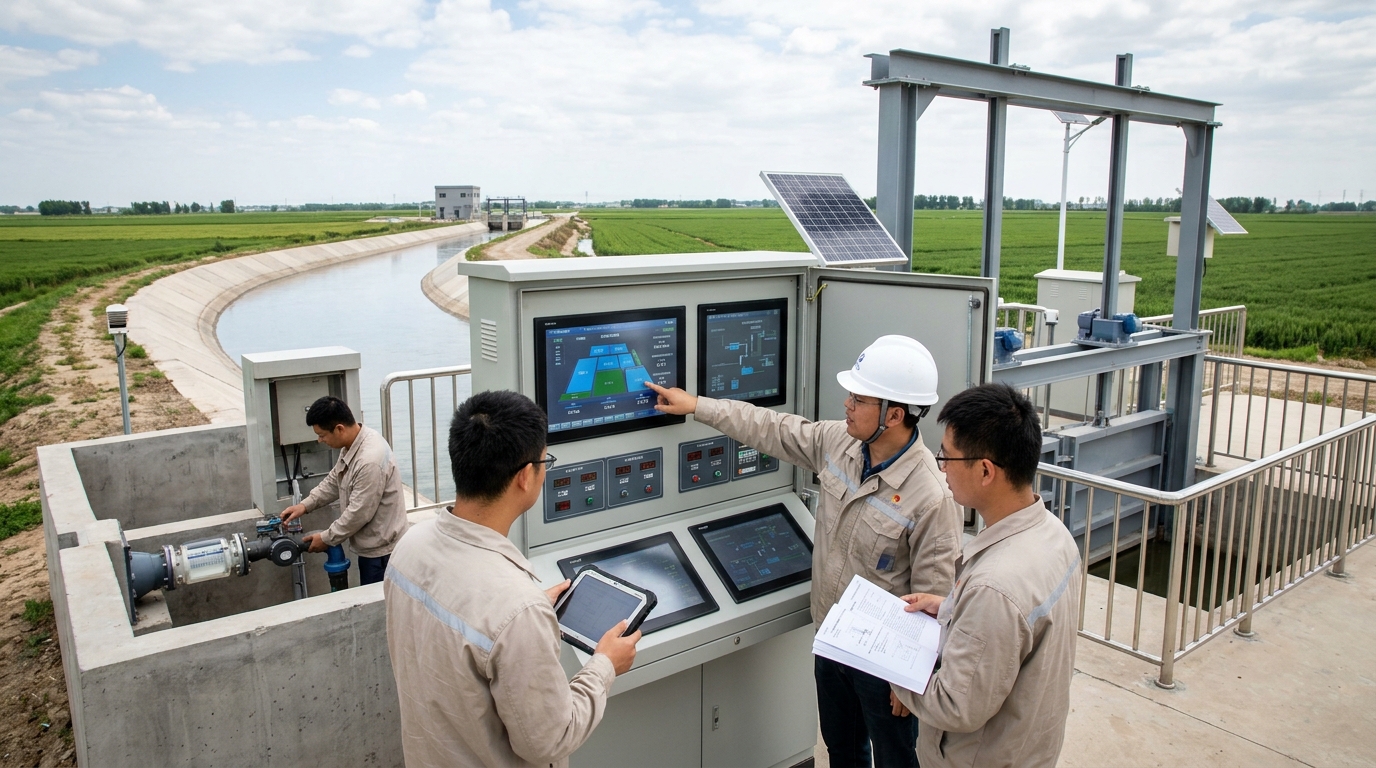
An irrigation district informatization system typically consists of a sensing layer, network layer, control layer, and platform layer. The sensing layer includes water level gauges, flowmeters, soil moisture sensors, weather stations, gate opening sensors, voltage and current monitors, and video surveillance; the network layer can utilize 4G/5G, fiber optics, NB-IoT, LoRa, or BeiDou short messages; the control layer comprises RTUs, PLCs, gate control cabinets, frequency conversion cabinets, and solenoid or motorized valves; the platform layer handles data aggregation, alarming, water allocation planning, remote control, reporting, and permission management.
Equipment Selection Guidelines
- Open-channel water measurement: Radar water level gauges (range 0.5–30m, accuracy ±3mm–±1cm), ultrasonic open-channel flowmeters, electromagnetic flowmeters, or Parshall flumes.
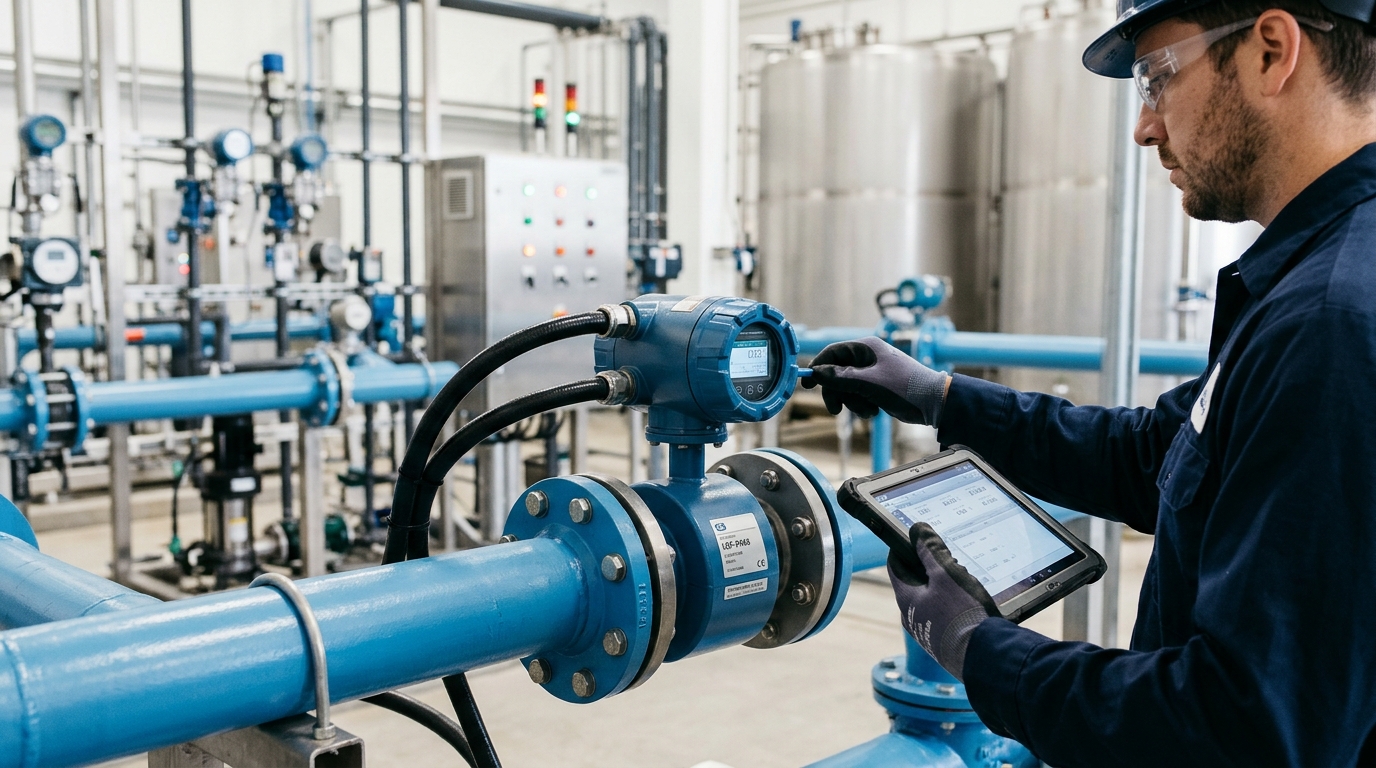
- Pipeline measurement: Electromagnetic flowmeters with accuracy of ±0.5% to ±1%.
- Soil moisture sensors: Installed at depths of 10cm, 20cm, 40cm, and 60cm; data collection cycle 15min–1hr.
- Protection ratings: Field control cabinets ≥ IP55; outdoor enclosures ≥ IP65.
- Solar power systems: Must support 3–7 consecutive cloudy/rainy days.
Key performance indicators should be clearly specified during bidding and acceptance:
- Data completeness rate ≥ 98%
- Remote command response time ≤ 30 seconds
- Gate opening control error ≤ 1% or 1 cm
- Comprehensive water measurement error ≤ 5%
- Platform alarm delay ≤ 5 minutes
For gates involved in flood control, ice jam prevention, and water supply safety, on-site manual override priority must be retained, and hard limiters and emergency operation interfaces should be installed.
Installation Steps: Survey First, Civil Works Second, Integration Third
On-site survey before installation is the first step determining the success or failure of the project. Management units should organize joint surveys involving hydraulic, electrical, communication, civil, and operational personnel, focusing on confirming channel cross-sections, flow capacity, siltation conditions, power supply, communication signals, lightning protection and grounding, traffic and maintenance conditions, and flood season operational risks.
Point selection should follow the principle of "mandatory measurement at key cross-sections, mandatory control at diversion outlets, and visual monitoring at risk nodes," prioritizing locations at main canal diversion gates, branch canal inlets, lateral canal measurement cross-sections, well outlets, drainage gates, and canal sections prone to siltation or over-extraction.
Hydraulic Installation Requirements
The installation of water measurement equipment must satisfy hydraulic conditions. Open-channel flowmeters should avoid sharp bends, drops, backflow, and gate disturbance zones, with straight sections maintained upstream and downstream of the measurement cross-section. If a Parshall flume is used, the throat must be level, and the flume centerline must align with the channel centerline; post-installation, the stage-discharge relationship must be verified.
When installing electromagnetic flowmeters in pipelines, the upstream straight pipe section should generally be no less than 5 pipe diameters, and the downstream section no less than 3 pipe diameters; sensors should avoid strong electromagnetic interference and severe vibration. Radar water level gauge mounting brackets must be stable, with no obstructions such as railings, branches, or cables within the beam angle, and the installation height should be determined based on the measurement range and flood water level.
Gate and Actuator Installation
The installation of gates and actuators should simultaneously complete mechanical limiting, opening indication, and electrical protection. Motorized gates should be equipped with manual/automatic switching devices. Control cabinets must clearly label open, close, stop, and emergency stop buttons, and be configured with overload, phase loss, and overcurrent protection. After installing the opening sensor, full-open and full-close mechanical calibration should be performed, avoiding sole reliance on electrical limits.
Power and Communication Construction
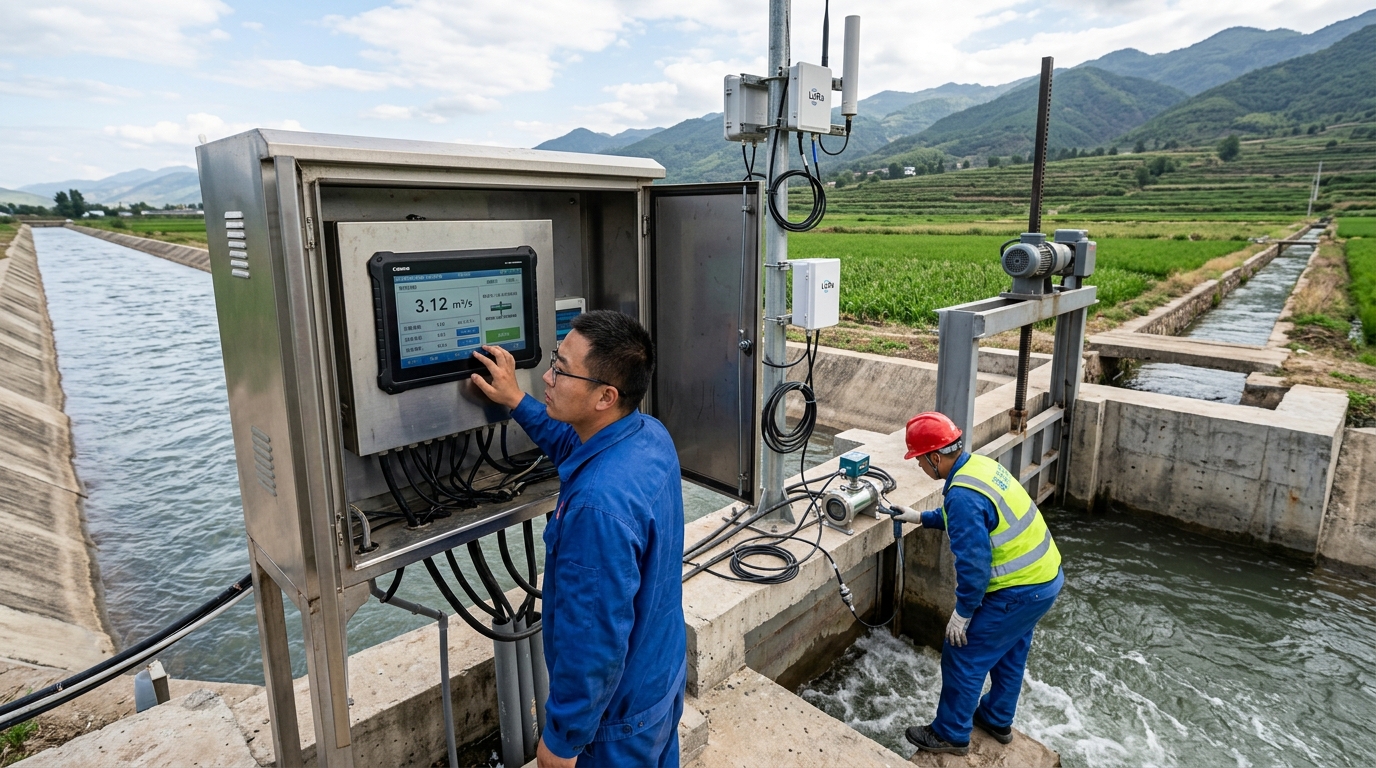
Power and communication construction must emphasize lightning protection and waterproofing. Sites without grid power typically adopt a solar plus battery solution. A single system can be configured with 100W to 300W solar panels and 65Ah to 200Ah batteries, with specific capacity calculated based on equipment power consumption, communication mode, and consecutive cloudy days. Solar panels should face south, with the tilt angle adjusted according to the local latitude.
Communication antennas should avoid shielding by metal enclosures, and 4G/5G antennas should be installed higher than surrounding obstructions. All outdoor cables should be laid in conduits, junction boxes must be sealed, and power, signal, and control lines should be routed separately. The grounding system must be reliable, with independent grounding resistance generally not exceeding 4 ohms; surge protectors for power and signals should be installed in areas prone to thunderstorms.
Commissioning Methods: From Individual Device Calibration to Closed-Loop Coordination
Commissioning should follow the sequence of "individual device before system, manual before automatic, monitoring before control." Individual device commissioning includes sensor power-on checks, address configuration, signal output verification, and local display verification. For commonly used RS485 communication devices, device addresses, baud rates, data bits, and parity bits must be verified; common parameters are 9600 or 19200 baud rate, 8 data bits, no parity or even parity, and 1 stop bit, and device addresses on the same bus must not be duplicated.
Data Calibration Core
Water level gauges should be compared with manual staff gauges or high-precision leveling measurements, covering at least three intervals: low, normal, and high water levels. Flowmeters should be cross-checked using cross-section parameters, current meters, or portable ultrasonic flowmeters; continuous cross-checking should last no less than 30 minutes.
Gate Coordinated Commissioning
Conducted under on-site supervision. Test local manual opening/closing first, then remote inching/setpoints/emergency stops, finally entering automatic control mode. Automatic control logic should set priorities: on-site emergency stop > remote control; safety protection > water-saving strategies.
Trial operation should include an observation period, recommended to be no less than 15 to 30 days, which can be extended to a complete rotational irrigation cycle during peak irrigation. Before acceptance, four types of documentation should be compiled: equipment parameter sheet, point coordinate sheet, control logic sheet, and fault alarm records. The platform data completeness rate, control success rate, and alarm accuracy rate must meet design requirements; otherwise, rectification should continue, and the system should not enter formal operation with existing faults.
Daily Maintenance: Establishing Periodic Ledgers
Irrigation district informatization equipment is exposed outdoors for long periods, making institutionalized maintenance essential. It is recommended to establish an O&M mechanism of "daily inspection, weekly verification, monthly maintenance, seasonal calibration, and annual evaluation."
- Daily inspections: Check platform for offline devices, abnormal data, unprocessed alarms, and failed remote control records.
- Weekly verifications: Check video images, gate status, battery voltage, and communication signals.
- Monthly maintenance: On-site cleaning of sensors, inspection of solar panels, tightening of wiring terminals, and cleaning of enclosure dust and pest infestations.
- Seasonal calibration: Spot-check key measurement data such as water level, flow, soil moisture, and rainfall.
- Annual evaluation: Produce an equipment health report based on the irrigation season's operation.
Maintenance focuses vary by equipment type. Radar and ultrasonic water level gauges require regular clearing of weeds, spider webs, and floating debris around brackets; open-channel measurement cross-sections should be desilted and weeded to prevent flow errors caused by cross-section changes; electromagnetic flowmeters require checking of grounding rings, liner wear, and electrode scaling; soil moisture sensors need inspection for cable damage and soil contact status; weather station rain gauges should have funnels and filters cleaned before the flood season to prevent blockage by leaves and dust.
The informatization platform also requires maintenance. Administrators should regularly back up databases; for critical irrigation districts, daily incremental and weekly full backups are recommended. Account permissions should be separated by role; operational, maintenance, and audit personnel should not share the same account. Firmware upgrades should be performed during non-critical irrigation periods, retaining rollback versions. For network security, remote access should use encrypted channels, and control commands should require secondary confirmation and operation logging to prevent misoperations and unauthorized control.
Common Troubleshooting: Step-by-Step Localization Along the Link
Common troubleshooting should follow the link sequence of "power—communication—device—parameters—platform" for localization, avoiding blind replacement of components.
Category 1: Device Offline / Communication Interruption
Check on-site power supply (solar controller output, battery voltage, fuse). If power is normal, check SIM card, antenna, router, and 4G/5G signal. For simultaneous multi-device outages, prioritize checking communication base station, fiber optic link, or gateway. For RS485 buses, check A/B line reversal, missing terminating resistors, and abnormal bus voltage.
Category 2: Abnormal or Jumping Data
Sudden water level changes often result from beam obstruction, loose brackets, floating debris, backflow, or gate discharge disturbance. Flow data deviation may stem from incorrect cross-section parameters, siltation, poor grounding, or upstream/downstream gate changes. Retrieve historical curves to distinguish instantaneous interference from systematic deviation.
Category 3: Gate Refusal to Move / Misoperation
If remote command issued but gate doesn't move: check control cabinet power, motor protector, manual/auto switch, communication module, and hoist mechanical jamming. If feedback doesn't change: check opening sensor, encoder coupling, and analog acquisition module. To prevent frequent starting/stopping damaging equipment, set minimum action intervals (e.g., 3–10 minutes).
Category 4: Insufficient Power / Lightning Strike Faults
Equipment going offline after continuous rain often relates to battery aging, dusty solar panels, or improper charging controller settings. Equipment damaged by lightning shows burned power modules, punctured communication ports, or abnormal data. Check if surge protectors activated and grounding resistance increased. Configure backup batteries or generators for critical seasons.
Smart Irrigation and Water-Saving Benefits: Practice in a Medium-Sized Irrigation District
Taking the renovation project of a medium-sized irrigation district as an example, the district has a designed irrigation area of 126,000 mu, originally relying mainly on canal water conveyance, with a water measurement facility coverage rate of about 61% and a high proportion of manual gate reporting and manual meter reading. The first phase of the project deployed 23 water measurement cross-sections on the main and major branch canals, renovated 17 motorized diversion gates, and built 12 new soil moisture and weather monitoring points, supported by 4G/5G communication, solar power, and a unified dispatch platform.
After implementation, the district's water measurement coverage rate increased to 92%, with basic remote monitoring and opening feedback achieved at main and branch canal diversion outlets. The management unit formulates rotational irrigation plans based on crop planting structure, rainfall forecasts, and soil moisture data. Gate dispatch has transformed from past telephone notifications and manual on-site attendance to platform dispatching, remote execution, and process tracing.
After one irrigation season of operation, the effective utilization coefficient of irrigation water in the district increased from 0.52 to 0.57, per-mu irrigation water consumption decreased by about 18%, and water abandonment in the main canal significantly reduced. Due to the traceability of measurement data, disputes over water fee collection have decreased, allowing grassroots management stations to redirect more effort toward channel desilting, water use coordination, and water-saving services.
This case also highlights key O&M points: initially, some open-channel cross-sections experienced flow deviations due to untimely desilting, which was resolved through seasonal cross-section re-measurement; two solar-powered sites suffered from insufficient winter power supply due to tree shading, rectified by relocating solar panels and increasing battery capacity. This demonstrates that irrigation district informatization does not end with equipment installation; it requires continuous calibration and optimization during operation to truly form stable smart irrigation capabilities.
Concluding Outlook: From Project Construction to Long-Term Operation
In the coming period, irrigation district informatization will develop towards standardization, modeling, and intelligence. On one hand, water measurement, gate control, water fee collection, and project management will gradually be integrated into a unified data foundation, forming a full-chain data closed loop from water sources, canal systems, and fields to users. On the other hand, digital twin irrigation districts, water demand prediction, canal system hydraulic models, and fault early warning will increasingly enter actual dispatch scenarios.
For management units, the construction focus should shift from "whether there is equipment" to "whether the data is accurate, the control is stable, and the O&M can keep up." In promoting smart irrigation, we must adhere to water-saving priority, safety baselines, and practical orientation. New projects should clearly define measurement accuracy, control response, data completeness rate, and O&M funding sources during the design phase; existing projects should improve operational quality through calibration, supplementary point deployment, renovation, and institutional refinement.
Only by solidifying installation, commissioning, maintenance, and troubleshooting can irrigation district informatization truly translate into water-saving, dispatch, and management capabilities, providing stable support for agricultural modernization and intensive, economical water resource utilization.