Low-Cost High-Density Water Sensing Networks: Architecture Design and Deployment Engineering
Engineering a high-density, cost-effective sensing network without sacrificing measurement quality is one of the defining challenges of modern smart water infrastructure.
The density of monitoring points in a water distribution network directly determines the granularity of operational intelligence. Yet water utilities worldwide face a persistent dilemma: high-precision sensors are prohibitively expensive for large-scale deployment, while low-cost alternatives often compromise data reliability.

1 The Cost Barrier in Conventional Architectures
Consider a mid-sized city with approximately 800 km of distribution mains (DN100 and above). Deploying pressure and flow monitoring at 2 km intervals requires 400 stations.
Using imported electromagnetic flowmeters (¥8,000–15,000 per unit) and industrial RTUs (¥5,000–8,000 per unit), hardware costs alone exceed ¥5 million. Add civil works, power supply, and communication infrastructure, and the total easily surpasses ¥10 million — before accounting for ongoing maintenance and calibration.
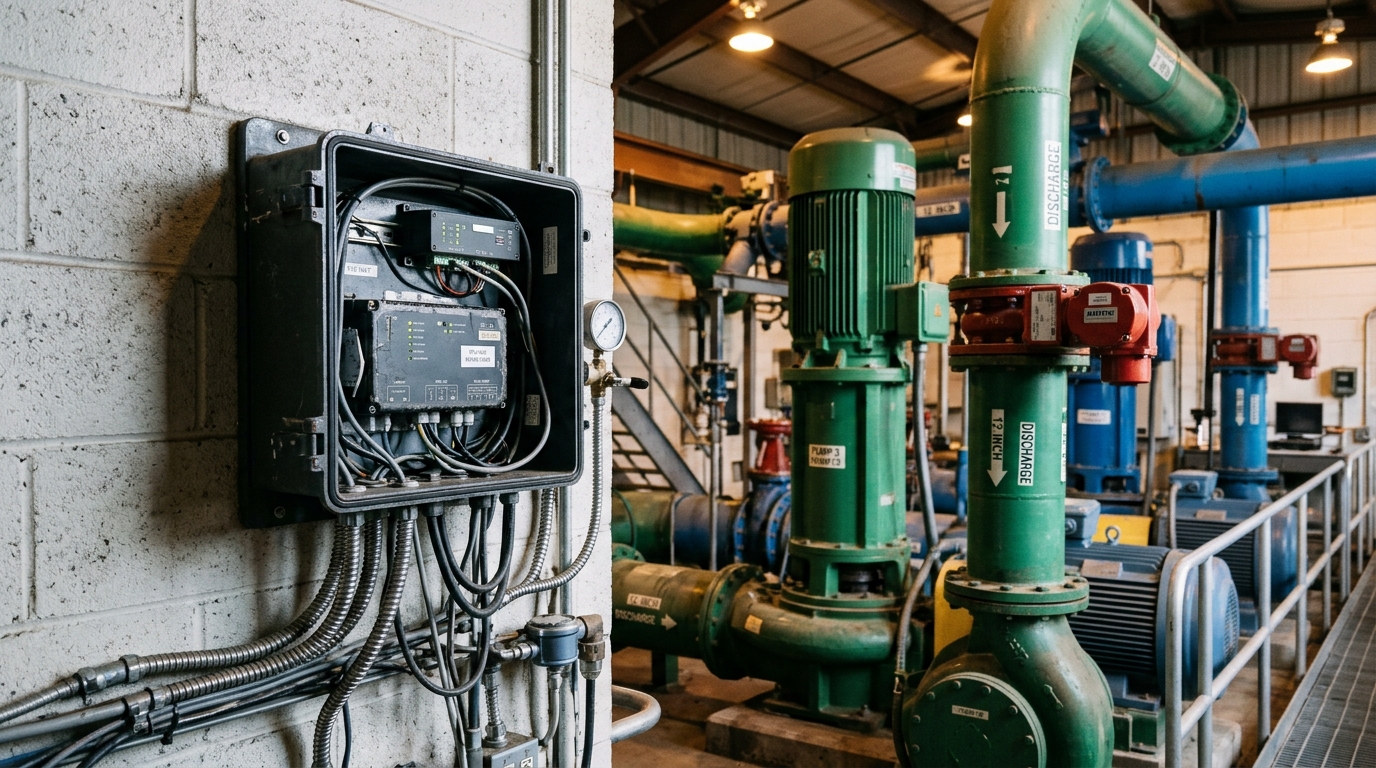
Moreover, the traditional three-tier star topology (sensor → RTU → central SCADA) demands independent power and connectivity at every node. In remote pumping stations, underground vaults, and network extremities, both mains power and 4G coverage are often unavailable, severely limiting the number of viable deployment sites.
2 Architecture Design Principles for High-Density, Low-Cost Sensing
Sensor Layer: Domestic Alternatives
The LGF-series electromagnetic flowmeter (compliant with OIML R49 Class 1, ±0.2% accuracy, IP68 rated) is now available at ¥850 for DN50 — roughly one-tenth the cost of equivalent imported units.
- Silicon piezoresistive pressure modules: ¥80–150
- Guiding principle: Functional specialisation
- System-level accuracy via spatial redundancy
Communication: LoRa + NB-IoT Hybrid
In dense urban areas, LoRa gateways (2–5 km radius, 200+ nodes per gateway) form the backbone of the sensing network.
- Per-node comms cost reduced to ~¥30 (vs. ¥80 for 4G)
- Fallback to NB-IoT in coverage gaps
- Hybrid architecture reduces comms costs by >60%
Edge Computing: Intelligent RTU Offloading
Lightweight RTUs (e.g., HERO V9 series, ¥1,200–2,000) perform local data cleaning and anomaly detection.
- Burst detection via pressure transient analysis
- Only critical data pushed upstream in real time
- Reduces uplink data volume by ~70%
Power: Solar + Battery Hybrid
For off-grid sites, a 30 W solar panel paired with a 12 V / 20 Ah LiFePO₄ battery provides robust autonomy.
- Total cost ~¥400
- 7+ days autonomous operation under overcast conditions
- Enabled by RTU low-power design
3 Deployment Case Study and Cost Breakdown
200-Point DMA Deployment Analysis
| Component | Unit Cost (¥) | Notes |
|---|---|---|
| Sensors (Flow + Pressure + Turbidity) | 1,570 | ¥850 + ¥120 + ¥600 |
| RTU Terminal (HERO V9) | 1,500 | Edge processing capable |
| Communication Module | 40 | LoRa/NB-IoT hybrid |
| Power System | 400 | Solar + Battery |
| Installation & Accessories | 500 | Civil works & cabling |
| Total Per Point | ~4,010 |
Total hardware cost for 200 points: approximately ¥800,000 — one-sixth of the conventional approach. Post-deployment, pressure monitoring coverage increased from 12% to 85%. Night-time minimum flow analysis identified 23 hidden leaks in the first year, with estimated water savings exceeding ¥1.2 million.
4 Engineering Considerations
Ingress Protection
All in-chamber installations must meet IP68 (IEC 60529). Cable joints should use potting compound sealing to prevent signal drift from condensation.
Communication Resilience
Deploy LoRa gateways in 1+1 redundancy. Critical nodes should maintain an NB-IoT fallback link. Use MQTT QoS 1 to guarantee delivery of alarm messages.
Sensor Drift Management
Low-cost sensors exhibit non-negligible long-term drift. Implement a 6-month online calibration cycle using hydraulic model back-calculation as a reference baseline.
Platform Integration
RTUs must support multi-protocol uplink (Modbus RTU/TCP, MQTT, HTTP) to ensure seamless integration with mainstream SCADA platforms (e.g., GE iFIX, Siemens WinCC, Ignition).
Conclusion
A high-density, low-cost water sensing network is not about "buying cheap sensors." It is a systems-engineering approach that reduces total cost of ownership through four concurrent strategies: domestic sensor substitution, hybrid communication architectures, edge-computing bandwidth reduction, and solar-powered off-grid operation.
For small and medium-sized water utilities with constrained budgets but urgent monitoring needs, this architecture offers a proven, economically viable path to comprehensive network visibility.