Low-Cost High-Density Water Sensing Networks: Architecture Design and Deployment Strategies
1. Introduction: The Density-Budget Paradox
Aging water infrastructure and increasing climate volatility demand denser real-time monitoring than most utilities can afford. The challenge is not merely technical—it is economic. A mid-sized city with 2,000 km of water mains requires 200–400 monitoring points for effective hydraulic model calibration and leak localization, yet most utilities operate with fewer than 50. This monitoring gap directly undermines District Metered Area (DMA) effectiveness, delays burst detection, and compromises regulatory compliance under frameworks such as the EU Water Framework Directive and ISO 24510.
The Objective: Reduce per-node investment by over 50% while increasing monitoring density 3–5×. This requires a systems-engineering approach that balances cost, accuracy, and reliability at every layer of the architecture.
2. Layered Architecture Design
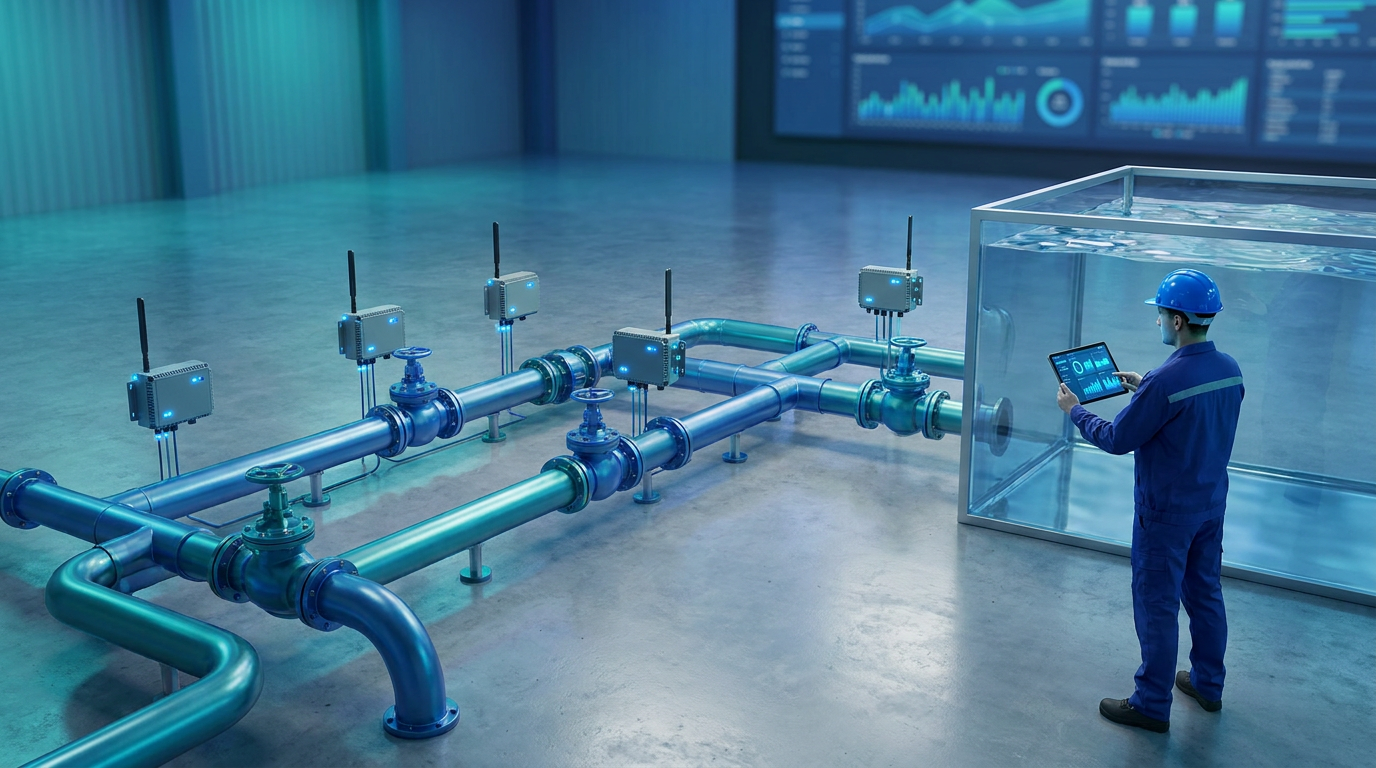
A cost-optimized sensing network follows a decoupled, three-layer model to ensure scalability and independent technology refresh cycles:
Perception Layer
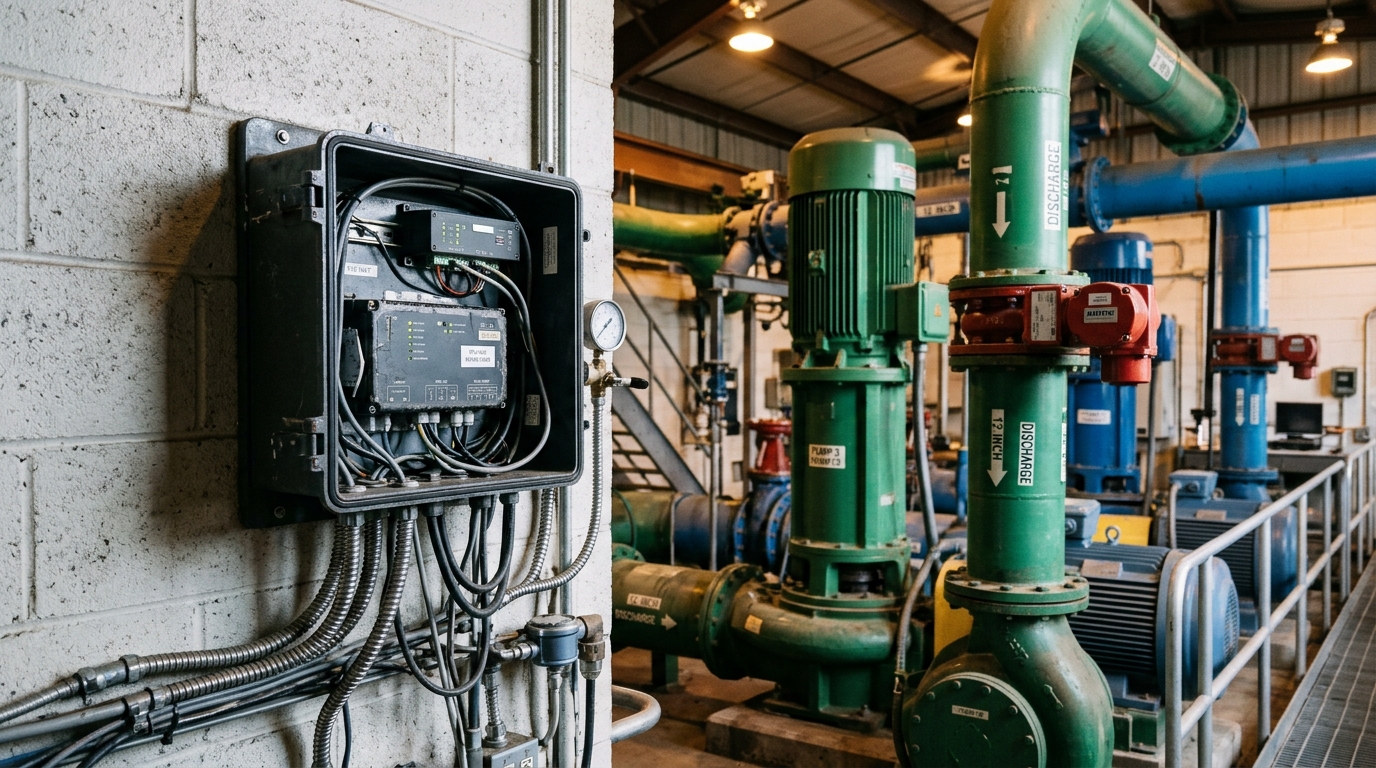
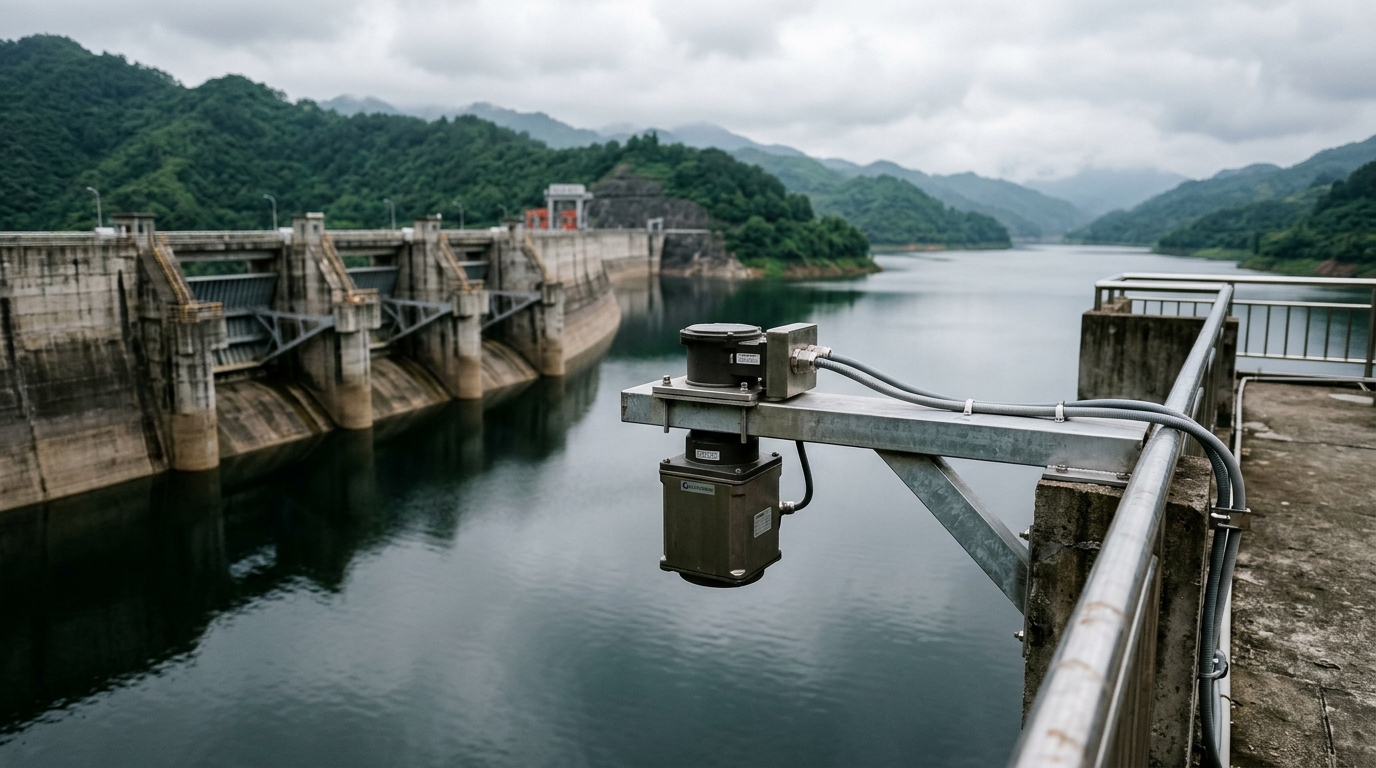
Field sensors (electromagnetic flowmeters, radar level sensors, pressure transducers) connected to RTUs. Hardware is modular—a common RTU mainboard accepts swappable sensor modules for plug-and-play deployment.
Communication Layer
Hybrid wireless connectivity combining LPWAN (LoRa, NB-IoT) for battery-powered underground nodes and cellular (4G Cat.1) for mains-powered pump stations and valve chambers.
Platform Layer
Cloud or on-premise data processing with time-series databases, anomaly detection pipelines, and hydraulic model integration (EPANET/WaterGEMS APIs).
This separation allows independent technology refresh cycles—sensors can be upgraded without replacing the communication infrastructure, and vice versa.
3. Communication Protocol Selection
Underground environments pose severe RF challenges. Field measurements below manhole covers (1.5 m depth) reveal distinct performance profiles:
- NB-IoT: Penetration loss of 25–30 dB; packet loss rates of 8–15% under manhole covers. Suitable for low-frequency reporting (15-minute intervals) with CoAP/LwM2M protocols.
- LoRa (868/470 MHz): 5–8 dB better penetration than NB-IoT. A submersible antenna inside the manhole paired with a street-level gateway achieves reliable link budgets. Ideal for private network deployments with custom duty cycles.
- 4G Cat.1: Adequate bandwidth but ~200 mW power draw—appropriate only for mains-powered installations per IEC 62056-62 standards.
Recommended Approach
Deploy LoRa as the primary backbone for underground nodes (gateways at surface distribution cabinets or streetlight poles) with NB-IoT as a complementary overlay for above-ground assets.
4. Optimal Sensor Placement (OSP)
Random sensor deployment wastes budget on redundant data while leaving critical gaps. Graph-theoretic OSP methods use the network topology as input and maximize information entropy to identify optimal locations:
- DMA boundary nodes: Mandatory flowmeter + pressure sensor at every DMA inlet/outlet per IWA guidelines.
- Topological critical points: Junction nodes at loop intersections and pipe diameter transitions receive priority.
- Sensitivity-driven placement: Hydraulic model sensitivity analysis (EPANET-based Monte Carlo simulation) identifies pipe segments most responsive to pressure/flow perturbations.
This approach typically achieves 90%+ leak detectability with 30% fewer sensors than uniform grid placement.
5. Edge Computing and Data Quality
Each RTU runs a lightweight data processing pipeline to manage bandwidth and ensure data integrity:
Signal Preprocessing
Median filtering to reject spike noise; moving-average smoothing for turbulent flow readings.
Anomaly Detection
Adaptive thresholding (μ±3σ from rolling baselines) and CUSUM change-point detection, compliant with OIML R49 verification requirements.
Data Compression
Normal-state telemetry transmits only statistical summaries (mean, max, σ). Anomaly-triggered mode switches to 1 Hz sampling for forensic analysis.
This edge intelligence reduces cellular data consumption by 70%+ while maintaining sub-second responsiveness to critical events.
6. Deployment Best Practices
Field experience from multiple utility deployments yields the following engineering recommendations:
- Phased rollout: Establish the primary DMA framework first, then progressively densify secondary and tertiary zones. This preserves ROI at each stage.
- Power autonomy: Underground nodes use Li-SOCl₂ battery packs (≥50 Ah, 3-year service life) with optional solar trickle charging per IEC 60068 environmental testing.
- Ingress protection: All subsurface equipment must meet IP68 (IEC 60529) with ≥40 kA surge protection and EMC immunity per IEC 61000-4 series.
- Calibration protocol: Deploy a 1–3 month parallel comparison period using portable reference instruments (±0.1% accuracy) to establish site-specific calibration curves for low-cost sensors.
7. Conclusion
A low-cost high-density water sensing network is not simply "more cheap sensors." It is a carefully engineered system that balances precision tiers, communication optimization, edge intelligence, and topology-aware placement. When properly architected, utilities can achieve 40–60% cost reduction while maintaining the data density required for effective DMA metering, NRW reduction, and predictive asset management.
The key insight: invest in architecture, not just hardware.