Development Opportunities for Low-Carbon Parks in 2026 in the Context of the Dual Carbon Goals
From energy consumption control to carbon asset management: How industrial parks are reshaping their competitive edge.
01 Introduction: The Shift to Measurability and Tradability
Against the backdrop of the continuous advancement of the "dual carbon" goals, industrial parks are shifting from mere production spaces to crucial vehicles for energy transition and industrial emission reduction. Industry estimates generally indicate that carbon emissions from various industrial parks and functional zones nationwide account for over 30% of China's total carbon emissions.
At the policy level, the "1+N" dual carbon policy framework is being continuously refined, with the dual control of energy consumption gradually shifting to the dual control of carbon emissions. During the 14th Five-Year Plan period, the target for reducing CO₂ emissions per unit of GDP is about 18%. This means park management will no longer focus solely on electricity consumption but will place greater emphasis on green power proportions, carbon emission intensity, and carbon asset management.
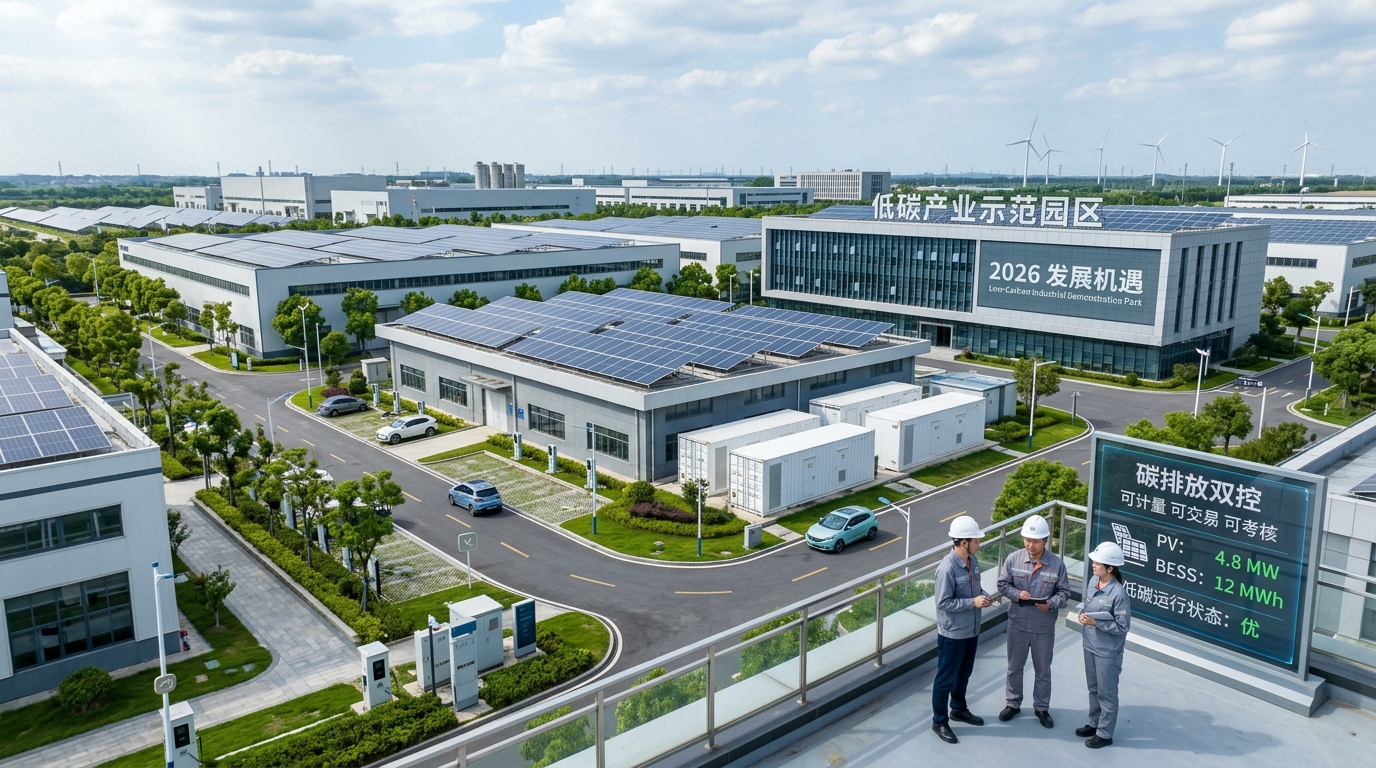
In practice, low-carbon parks are developing into a systematic engineering project featuring the synergy of "source, grid, load, storage, and carbon."
02 Market Trends: The Main Battlefield for Dual Carbon Goals
The low-carbon park market is undergoing three major shifts driven by industrial imperatives rather than just government demonstrations:
- Demand Driver Shift: Export-oriented manufacturers, data centers, and new energy battery industries are proactively demanding traceable green energy due to supply chain carbon footprint requirements (e.g., EU Carbon Border Adjustment Mechanism).
- Service Model Evolution: Moving from single-point equipment savings to integrated energy operations. Parks are adopting unified platforms incorporating distributed PV, energy storage, heat pumps, and demand management. For instance, in regions with peak-valley price differences exceeding 0.7 yuan/kWh, investment payback periods can be shortened to 4–7 years.
- Asset Transformation: Green assets are shifting from cost items to operational items. A 10 MW rooftop PV system can reduce approximately 5,700–6,800 tons of CO₂ annually, providing not just cost savings but also a foundation for carbon verification and green power trading.
03 Technology: EMS Evolves to Synergistic Optimization
The New Generation EMS
The Energy Management System (EMS) is upgrading from a "visualization dashboard" to an "operation optimization hub." It now simultaneously processes multiple energy types (electricity, heat, cooling, gas, water) and connects to diverse equipment via real-time load forecasting and strategy linkage.
Load Forecasting
Predicts power demand 15 mins to 24 hours ahead to adjust AC and storage proactively.
Demand Management
Controls maximum demand near declared values, reducing basic electricity fees by 5–15%.
Carbon-Power Synergy
Links green power generation and carbon factors, making every kWh's carbon footprint traceable.
Notably, AI and large models are entering park energy management. Traditional rule engines are being replaced by AI algorithms that learn equipment efficiency curves, predict faults, and recommend strategies. For example, chiller plant group control systems can automatically select optimal start-up combinations based on outdoor wet-bulb temperature and electricity price signals.
04 Energy Efficiency: From Retrofitting to System Tuning
Energy efficiency improvement is shifting from "replacing equipment" to "tuning systems." While replacing high-efficiency motors remains important, the marginal returns are declining. The critical focus is now on system matching and operation strategy optimization.
- Central Air Conditioning: Through group control strategies and optimization of temperature/pressure differences, distribution energy consumption can be significantly reduced while maintaining comfort.
- Compressed Air Systems: If leak rates exceed 10%, power consumption increases significantly. Leak detection and pressure grading can achieve 10–25% energy savings.
- Data Centers: With PUE targets dropping below 1.3 (and advanced projects approaching 1.15), technologies like indirect evaporative cooling and liquid cooling are becoming standard.
05 Policy Impact: Reshaping Investment Logic
Policy is the core variable. The gradual shift from dual control of energy consumption to dual control of carbon emissions drives parks to establish new indicator systems.
Green Power & Certificates
Green certificates are becoming key evidence for low-carbon energy use. For park operators, the proportion of green power consumption may become a core indicator in investment promotion materials to attract multinational enterprises.
National Carbon Market
With average transaction prices around 85 yuan/ton in 2024, carbon costs are beginning to affect project feasibility. As prices rise, the economics of energy-saving retrofits and green power substitution will improve, shifting transformation from policy-driven to cost-and-policy-driven.
06 Business Models: Integrated Operation
The business model is shifting from engineering delivery to long-term operations. Parks can obtain diversified revenues through energy trusteeship, peak-valley arbitrage, demand management, and carbon asset development.
Different park types have formed differentiated paths:
- Industrial New City Parks: Focus on integrated energy infrastructure (PV, storage, waste heat utilization).
- International Cooperation Parks: Emphasize passive buildings, ground-source heat pumps, and green building standards.
- New Energy Clusters: Rely on wind/solar resources for direct green power supply and source-grid-load-storage integration.
However, challenges remain. Some parks emphasize construction over operation, lacking continuous data governance. Others face fragmented rules for carbon accounting and green certification. To form true competitiveness, parks must shift from "project-based" to "operation-based" approaches.
07 Forward-Looking Insights: Key Trends for 2026+
Flexible Synergy
Energy systems will shift from "ensuring supply" to "flexible synergy." Parks will become aggregations of adjustable loads, participating in virtual power plants and demand response to create new revenue streams.
Digitalization as Infrastructure
Digitalization will upgrade from monitoring to carbon management infrastructure. Achieving a closed loop of "energy data—carbon emission data—product carbon footprint—green certification" will be essential for export compliance.
Carbon Asset Participation
Green finance tools (credits, bonds, REITs) will deeply participate in park operations. Operators need to shift from "property management" to "energy asset + carbon asset management."
Conclusion: From Demonstration to Scale
Overall, low-carbon parks have moved from conceptual exploration to large-scale implementation. Park low-carbon transformation is no longer a single-point environmental investment but a systematic engineering project involving energy structure, industrial structure, digital capabilities, and asset operation capabilities.
Looking ahead, truly competitive low-carbon parks will not simply possess solar panels or monitoring systems, but will be able to continuously reduce carbon emissions per unit of output value and translate these data into credible assets. Only when low-carbon capabilities become the underlying capacity for long-term operation can the dual carbon goals truly take root in industrial spaces.