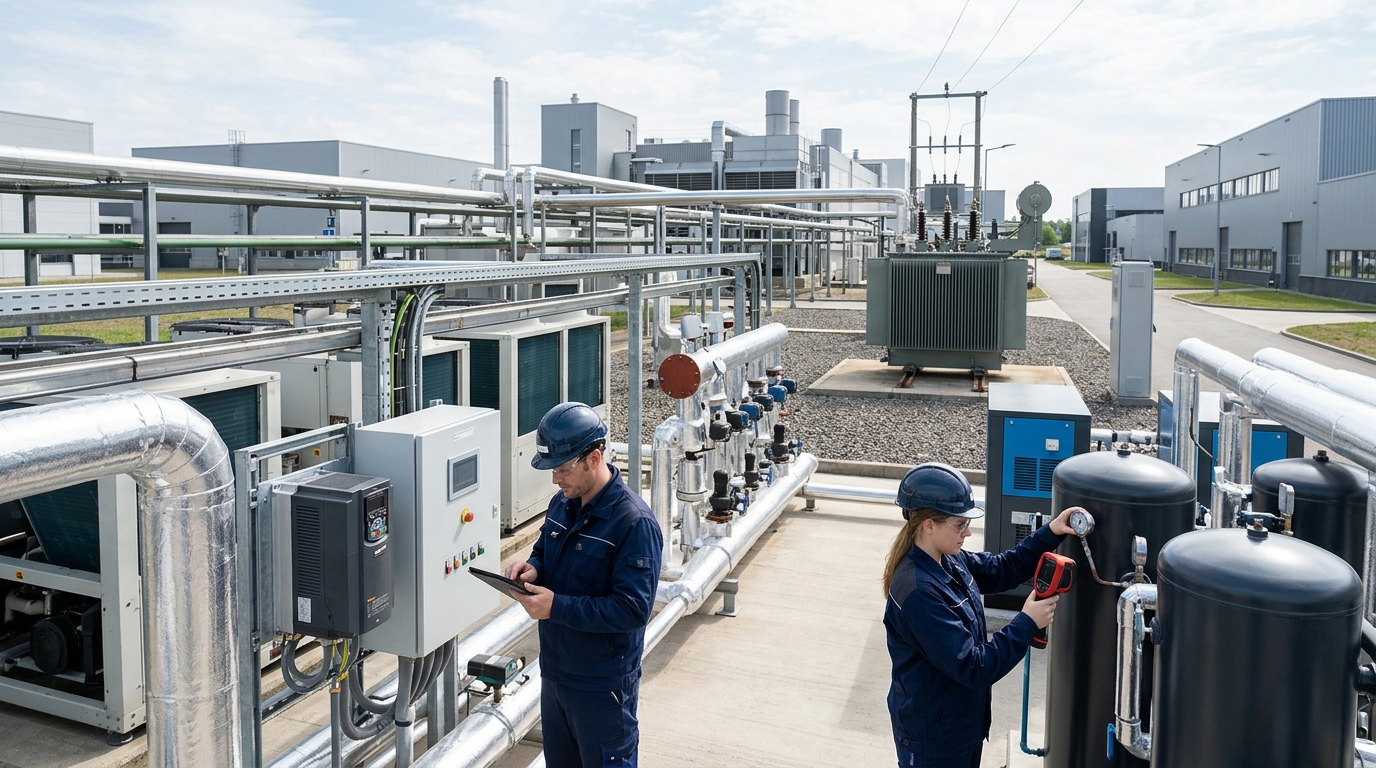
Low-Carbon Park Digital Transformation: Breaking Data Silos with IoT Platforms
As the "dual carbon" goals transition from macro commitments to enterprise costs and supply-chain compliance, low-carbon parks are evolving into new-type industrial infrastructure. This article explores how Energy Management Systems (EMS) and IoT platforms are reshaping park operations, moving beyond simple energy monitoring to comprehensive carbon accounting and flexible load management.

Introduction: From Demonstration Projects to Industrial Infrastructure
China currently hosts over 20,000 development zones, high-tech zones, and industrial parks. These entities contribute approximately 50% of industrial output, consume 60% of industrial energy, and account for 30% of industrial CO2 emissions. Consequently, parks serve as both centralized energy consumption units and key scenarios for implementing carbon management.
The competitive focus of low-carbon parks is shifting from "installing solar PV and replacing equipment" to "whether energy-carbon data are credible, loads are flexible, boundaries are clear, and benefits are verifiable."
Over the next five years, decarbonization will no longer be merely an environmental task but a core component of investment attraction, production efficiency, and export compliance. EMS and energy-efficiency optimization are becoming the operating systems connecting the equipment layer, management layer, and market layer.
Market Trends: From "Watching Meters" to "Calculating Carbon Accounts"
Demand-Side Segmentation
- Heavy Industry: Focus on steam, compressed air, boilers, and waste heat recovery.
- Electronics: Cleanroom HVAC, IT loads, and green electricity share.
- Logistics: Cold storage, charging stations, and rooftop PV.
- Data Centers: PUE optimization, chiller group control, and liquid cooling.
Supply-Side Evolution
EMS is upgrading from a "meter-reading system" to an "energy-carbon operations platform."
Key capabilities now include load forecasting, demand control, peak-valley arbitrage, carbon emission accounting, and green certificate reporting.
Industry calculations suggest significant potential savings through optimized control:
- HVAC Optimization: 10%–25% energy savings.
- Compressed Air Management: 8%–20% electricity savings.
- Intelligent Lighting: 15%–40% electricity savings.
- Data Center PUE Reduction (1.40 to 1.25): ~10%–15% reduction in electricity costs.
Policy Impact: Reshaping Park Boundaries
China’s "1+N" policy system has clarified emission-reduction pathways. As the national carbon emissions trading market expands to steel, cement, and aluminum smelting, carbon price volatility directly affects operating costs. For parks with annual emissions of 100,000 tonnes, carbon cost differences can reach millions of RMB.
The Shift to Dual Control of Carbon
Policies are driving parks to establish a unified carbon ledger covering three scopes:
• Scope 1: Boilers, kilns, process emissions.
• Scope 2: Purchased electricity, heat, steam, cooling.
• Scope 3: Raw materials, logistics, employee commuting, waste.
Technology Direction: EMS, Digital Twins, and Flexible Loads
The core of technological evolution is making energy "perceivable, computable, controllable, and tradable." A robust EMS architecture includes four layers:
Smart meters, sensors, PLCs, inverters.
Cleansing, integration, completeness >95%.
Digital twins, AI prediction, MPC.
Optimization, reporting, trading.
Key performance indicators for mature parks include:
- Sampling frequency of 1-minute or 15-minute intervals for major energy types.
- Short-term load forecasting errors controlled within 5%–15%.
- Anomaly detection to work-order response time shortened to minutes.
Case Observations: Pathways Differ Across Park Types
Electronic Manufacturing Park (Yangtze River Delta)
Profile: 60 million kWh annual consumption; 8 MW rooftop PV; 2 MW/4 MWh energy storage.
Challenge: Coarse chiller strategies, high air-compressor pressure bands, and lack of PV/storage participation in demand optimization.
Solution: Linked HVAC supply water temperature with production scheduling; compressed air pressure bands; aligned energy storage dispatch with peak-valley prices.
Chemical Park (Northern China)
Focus: Steam System Optimization.
By combining EMS with field instruments, the park identified failed steam traps and insulation gaps. Through steam balance diagrams and online monitoring, steam losses were reduced by 5%–10%.
Impact: Equivalent to saving ~5,000 tonnes of standard coal and reducing ~13,000 tonnes of CO2e annually.
Energy Efficiency: From Point Retrofits to Systemic Savings
The difficulty lies not in whether energy-saving equipment exists, but in whether savings are verifiable. Mature projects use Measurement and Verification (M&V) methods such as IPMVP Options A, B, C, or D.
| Phase | Key Measures |
|---|---|
| Short-Term | Leak management, pressure-band optimization, lighting occupancy sensing, non-production shutdowns. |
| Medium-Term | Variable-frequency drives, chiller group control, waste heat recovery, steam trap management, energy-storage dispatch. |
| Long-Term | Process reconfiguration, electrification, hydrogen fuels, CCUS, digital twins, microgrids. |
Outlook: Energy-Carbon-Electricity Three-Network Synergy
Future low-carbon parks will exhibit synergy among three networks:
Energy Network
Metering and dispatching electricity, heat, gas, cooling, water, and steam.
Carbon Network
Scope 1/2/3 accounting, footprint tracking, and regulatory reporting.
Trading Network
Green certificates, spot markets, ancillary services, and carbon asset monetization.
Parks will evolve from mere consumers to "prosumers," leveraging rooftop PV, storage, and flexible loads as virtual power plant resources. However, risks remain regarding technology pathway uncertainties and data quality.
Adhere to the pathway: "Data foundation first, then system optimization, and finally market participation." The core value is not a zero-carbon label, but the continuous reduction of energy and carbon emissions per unit of economic output.
Conclusion: Entering the Refined Operations Phase
Low-carbon parks are undergoing a shift from engineering thinking to operations thinking. Over the next five years, park owners, enterprises, and service providers must jointly build systems that are measurable, reportable, verifiable, and continuously optimizable.
The long-term value of low-carbon parks lies not in completing a one-time retrofit, but in turning energy conservation, EMS, and dual-carbon management into continuously operating infrastructure. Parks that establish credible data and stable energy-saving benefits early will occupy a proactive position in industrial relocation and global supply chains.