How to Choose the Right Park Energy Management System? Accuracy and Stability Are Key
As industrial parks move from single property management to integrated energy services, objectives are no longer limited to meter reading or bill settlement. In complex scenarios like data centers and cold-chain logistics, systems face constraints including load fluctuations, equipment aging, peak/off-peak tariffs, and carbon accounting. The industry is shifting from "after-the-fact statistics" to a new stage of "real-time sensing, energy efficiency optimization, and dual-carbon synergy."
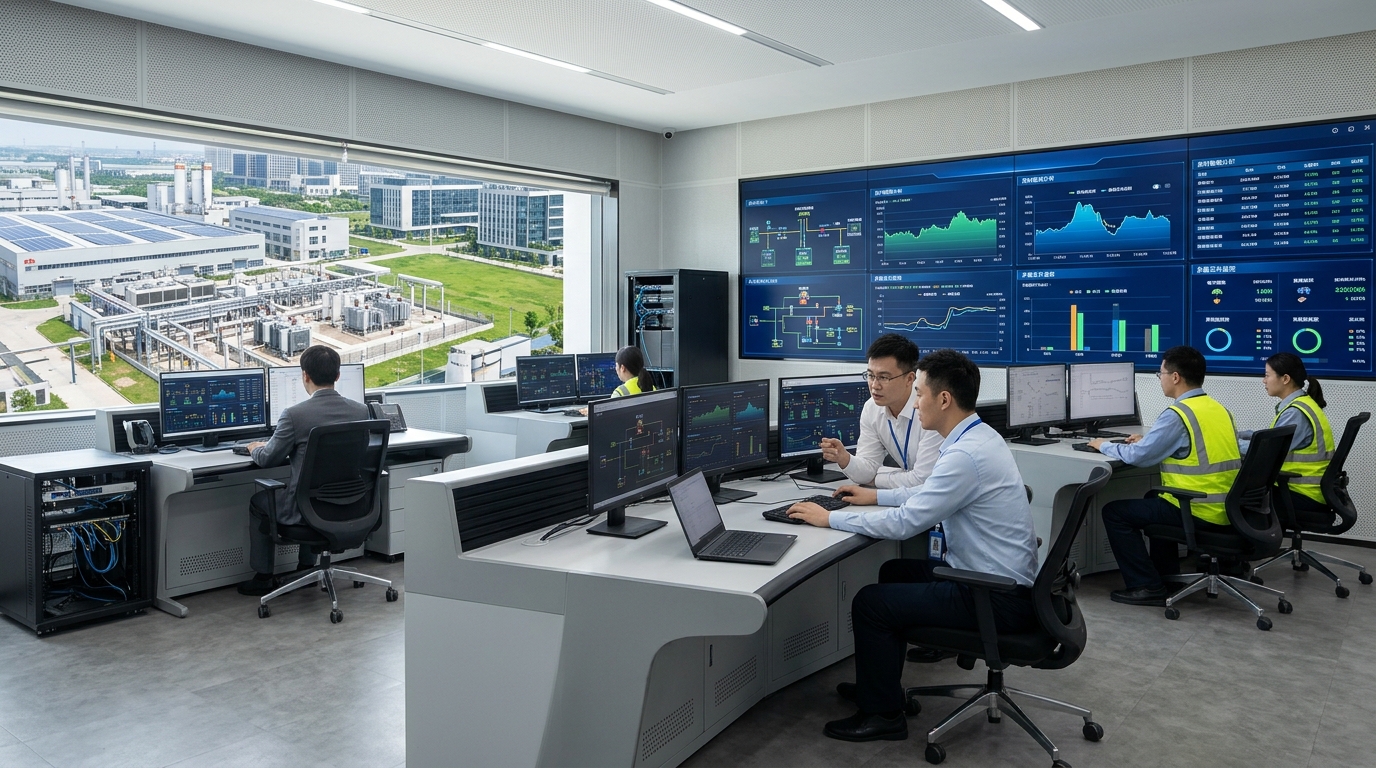
Technology Route Map: Defining Responsibilities
Current park energy management technology routes can be roughly divided into six categories. A mature park often needs bottom-layer metering, edge control, cloud analytics, microgrid dispatch, and a carbon data closed loop simultaneously. Differences in selection appear in acquisition frequency, control response, data ownership, and implementation period.
- Centralized EMS/SCADA: Emphasizes unified data acquisition, monitoring, alarms, and basic control.
- Edge Intelligent Control: Deploys algorithms and local control on gateways/PLCs for low-latency and network-disconnection autonomy.
- Cloud SaaS Platforms: Excels in multi-park access, visualization, benchmarking, and subscription services.
- Digital Twin & AI: Uses models to predict loads, cooling plant efficiency, PV output, and HVAC parameters.
- PV-Storage-Charging Microgrids: Focuses on source-grid-load-storage coordination, peak shaving, and green electricity consumption.
- Carbon Data Platforms: Converts energy data into Scope 1, 2, and 3 emissions accounting bases.
The core of technology route comparison is not only whether platform functions are rich, but whether they can operate stably in real park environments and convert data into executable energy-saving actions.
1. Centralized EMS and SCADA
Suitable for large parks and complex industrial scenarios, centralized EMS offers unified databases, permissions, and cross-system coordination. It can manage hundreds to thousands of metering points with second-level to 15-minute intervals. However, implementation periods are long (6–18 months), initial investment is high, and it requires robust network/server infrastructure.
Case Study: Equipment Manufacturing Park
With 120 million kWh annual consumption, this park deployed a centralized EMS connecting ~1,200 metering points. Investment was RMB 6.2 million. After 12 months, energy consumption per unit output value decreased by 6.8%, saving RMB 2.1 million annually, with a static payback period of about 3 years.
2. Edge Intelligence and Distributed Control
This route pushes computing and control logic to field devices (gateways, PLCs). Advantages include strong local autonomy, low latency (1–5 seconds), and offline availability. It is ideal for aging parks, multi-tenant scenarios, and areas with unstable networks. The main drawback is potential system fragmentation if controller versions vary across buildings.
Case Study: Logistics Cold Chain Park
Facing inconsistent chiller interfaces, this park used 12 edge gateways for protocol conversion and local group control. Cooling plant COP improved by 8%, saving RMB 2.6 million annually against an RMB 4.8 million investment, achieving a payback period of just 1.8 years.
3. Cloud SaaS and Digital Twin
Cloud platforms offer fast deployment (30–90 days) and strong visualization for multi-park management. Digital twins add predictive capabilities using historical and weather data. While effective for benchmarking, model performance depends heavily on data quality. If sensors are missing or control permissions are restricted, algorithm recommendations may fail to implement.
Case Study: Chain Industrial Park Operator
Managing 12 parks, the operator adopted a cloud platform for anomaly identification and benchmarking. Energy-saving rates ranged between 4% and 7%. Average daily load forecast MAPE was 8%, though newer parks showed higher errors due to insufficient historical data accumulation.
4. PV-Storage-Charging and Microgrids
This asset-oriented direction transforms parks from consumers to adjustable resource units. By coordinating rooftop PV, storage, and charging, parks can arbitrage peak/off-peak tariffs and increase green electricity share. PV self-consumption rates commonly range from 60% to 90%. Risks include fire safety approvals, battery degradation, and tariff policy fluctuations.
Case Study: Electronics Manufacturing Park
Built with 1.2 MW PV and 0.8 MW/1.6 MWh storage, the project generated 1.3 million kWh PV annually. Combined arbitrage and demand response revenues reached RMB 650,000/year. Total investment was RMB 9.8 million, with a 6-year payback period and 780 tons of annual carbon reduction.
5. Carbon Data Management
Under "dual carbon" goals, energy data must become verifiable and traceable. Carbon platforms map electricity, heat, and gas data to Scope 1, 2, and 3 emissions. This is critical for export-oriented enterprises facing supply-chain disclosure requirements. Without high-quality energy data, carbon platforms remain mere reporting tools; without them, energy data cannot serve green finance or compliance.
Selection Recommendations
Avoid "technology stacking." Start from business constraints:
Load Structure
For office/lighting-heavy parks, prioritize sub-metering and Cloud SaaS. For heavy industrial/data centers, prioritize Centralized EMS and Edge Control. For parks with PV/Storage, assess Microgrid interfaces.
Management Boundaries
Unified operators suit centralized platforms. Multi-tenant/multi-owner parks benefit from Edge Gateways + Cloud Analytics to balance control, privacy, and cost allocation.
Investment Capacity
Small parks: RMB 1-3M (1-2 yr payback). Large manufacturing: RMB 8-20M (3-5 yr payback). Microgrids: Larger investment, 4-8 yr payback depending on tariffs.
Compliance Needs
If facing ESG disclosure or key emission unit supervision, incorporate carbon data platforms early in the construction scope rather than as an afterthought.
A robust path is: Basic Metering → Edge Control → Cloud Analytics → Microgrid/Carbon Platforms. For existing SCADA systems, use gateways for smooth upgrades rather than tearing down and rebuilding.
Final Outlook
In the next 3–5 years, the focus will shift from "having an EMS" to achieving electricity-carbon synergy and market response. Parks will evolve from consumption units to virtual power plant nodes. Success depends not just on algorithms, but on the synergy of metering infrastructure, control permissions, O&M organization, and tariff mechanisms.
Park energy management is moving from single-point energy saving to system optimization, and from a cost center to a data asset center.