Smart Water Management Market Trends: 2026 Radar Water Level Sensor Price Trends and Selection Guide
Market Analysis • Industrial Sensors • Smart Water Infrastructure
Introduction: Upgrading Demands for Water Level Monitoring
Against the backdrop of frequent extreme rainfall, intensified urban waterlogging management, and the continuous digital transformation of water conservancy, water level monitoring is rapidly shifting from traditional manual reading and contact sensor measurements to automated, non-contact, and real-time monitoring. As one of the fastest-growing water level sensing devices in recent years, radar water level meters have been widely deployed in scenarios such as rivers, reservoirs, irrigation districts, urban underpasses, wastewater treatment plants, and industrial water tanks.
From an industry application perspective, the core value of radar water level meters lies in acquiring water level data in real-time, continuously, and stably. Particularly during the flood season, water levels change rapidly. Traditional float-type and pressure-type devices are susceptible to siltation, entanglement, and blockage. In contrast, radar water level meters transmit electromagnetic waves to the water surface and receive the echoes, enabling rapid calculation of water level changes. With the gradual maturation of 80GHz radar technology, equipment has seen further improvements in beam focusing, anti-interference capabilities, smaller blind zones, and adaptability to complex environments.
"Users are paying more attention to high accuracy, long-term stability, low power consumption, and post-maintenance costs, rather than simply comparing initial purchase prices."
Based on comprehensive channel feedback, the domestic radar water level meter market shows three distinct trends: increased localization rates forming multi-tiered supply; a shift from single devices to integrated solutions ("sensors + communication + power + platforms"); and a focus on total lifecycle costs over initial price tags.
Technical Routes: 80GHz Radar & Non-Contact Measurement
The technical foundation of radar water level meters is electromagnetic wave ranging. Unlike pressure-type or ultrasonic meters, the greatest advantage of radar water level meters is non-contact measurement: the sensor does not directly contact the water body, making it less affected by water quality, sludge, floating debris, oil, and corrosive media.
Why 80GHz?
While common products include 10GHz, 24GHz, and 26GHz solutions, 80GHz millimeter-wave radar has gained significant attention. The higher frequency results in a shorter wavelength and more concentrated energy, allowing for a smaller antenna size. The beam angle can typically be controlled between approximately 3° and 8°. A narrow beam means electromagnetic waves are more concentrated, resulting in less interference from echo reflections off channel walls, bridge piers, guardrails, and bank clutter. This makes them particularly suitable for scenarios with limited installation space, such as narrow channels, culverts, gate wells, and small water tanks.
Key Performance Metrics
- Measurement Range: Mainstream products range from 0.3m to 30m; long-range products reach 50–70m.
- Resolution: Can reach 1 millimeter.
- Accuracy: Common specs are ±2 mm, ±3 mm, or ±0.1% FS. High-end products can achieve ±1 mm under ideal conditions.
- Response Time: Mostly within 1 second, with sampling cycles adjustable from 1 second to 60 seconds.
However, radar water level meters are not without technical boundaries. Their performance can be affected by installation angle, water surface fluctuations, raindrops, steam, and foam. Therefore, mature products are typically equipped with algorithms for false echo learning, temperature compensation, raindrop filtering, and wave smoothing.
Market Size and Price Ranges: Clear Product Tiering
The market price of radar water level meters is not a single standard but is distinctly tiered based on frequency, measurement range, accuracy, ingress protection rating, and project integration depth. Based on public market quotes and bidding transaction prices, current domestic radar water level meters can be roughly divided into four price ranges.
Entry-Level Standardized
Basic Applications¥6,000 – ¥15,000
Ideal for simple environments like ordinary water tanks, landscape water bodies, and small pump stations.
- Range: 3–10m | Accuracy: ±5–10mm
- IP67 Protection | 4-20mA/RS485 Output
Mainstream 80GHz Integrated
Most Popular¥15,000 – ¥35,000
The mainstay for water conservancy, municipal, and irrigation district projects. High cost-effectiveness.
- Range: 0.3–30m | Accuracy: ±2–5mm
- 80GHz Narrow Beam | 4G/NB-IoT Support
High-End Industrial/Hydrological
Complex Environments¥35,000 – ¥80,000
For reservoirs, spillways, chemical tanks, and explosion-proof areas. Emphasizes stability and corrosion resistance.
- 316L Stainless Steel | IP68 Protection
- Wide Temp (-40°C to 80°C) | Dual Comms
Customized/Special-Condition
Special Projects¥80,000 – ¥120,000+
Long-range, special explosion-proof, anti-corrosion, or high-precision metering products for unique requirements.
- Intrinsically Safe Power Supplies
- BeiDou Backup | Custom Algorithms
Note on Total Project Cost: Users often procure a complete monitoring station, not just a sensor. Including poles, foundations, solar panels, batteries, RTUs, and platform integration, construction costs per station usually range from ¥30,000 to ¥150,000. Budget accordingly.
Application Scenario Cases
Radar water level meters have a wide range of application scenarios, but different scenarios have significantly different requirements. If users only procure based on the name "radar water level meter" while ignoring on-site working conditions, they may encounter issues such as insufficient blind zones, beam interference, and unstable communication.
River Hydrological Monitoring
Large installation height, large measurement range required.
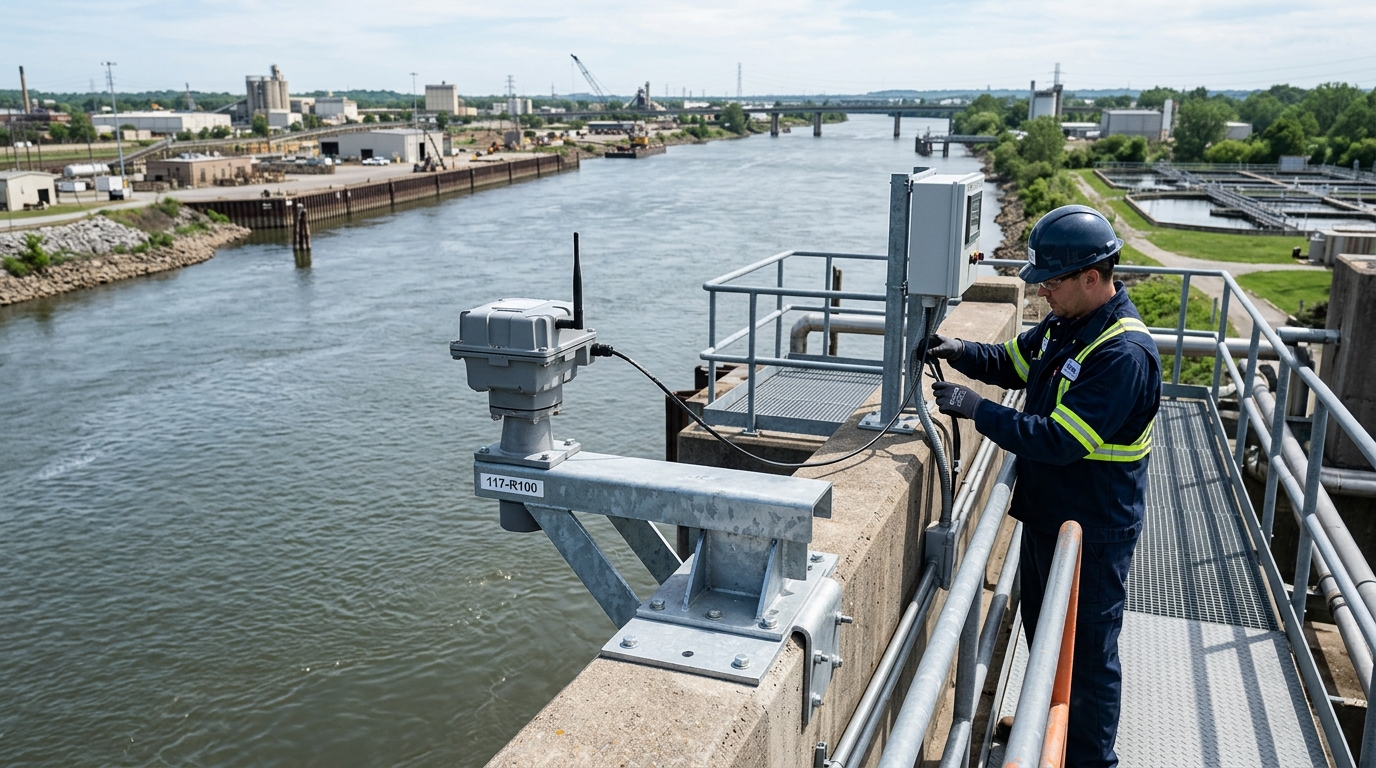
In a county-level river project, an 80GHz radar meter (0.3–10m range, ±3mm accuracy) was paired with solar power and 4G. After one year, data integrity remained above 98%, significantly improving flood process capture compared to manual observation.
Urban Underpass/Culvert
Emphasis on response speed, small blind zones, and linkage.
Installation heights are low, and water levels change rapidly. Products with a blind zone ≤0.3m and response time ≤1s are suitable. Systems can automatically link LED screens, alarms, and drainage pumps when thresholds (e.g., 5cm, 15cm, 25cm) are reached.
Reservoir & Spillway
High accuracy and long-term stability required.
Scenarios often have heavy water vapor, condensation, and frost. Equipment must resist drift under continuous rainfall. High-accuracy meters (±2mm) with lightning protection and dual power backup are recommended to reduce manual inspection frequency.
Industrial Tanks
Focus on corrosion resistance, explosion-proofing, and signal stability.
Locations like sludge tanks may contain foam, steam, and corrosive gases. It is recommended to choose PTFE antennas, 316L enclosures, IP67/IP68 protection, and algorithms resistant to steam and foam. Explosion-proof certification is mandatory for chemical tank farms.
Purchasing Recommendations: Confirm Item by Item
When purchasing a radar water level meter, the first step is not to compare prices, but to clarify on-site measurement requirements.
- Measurement Range: Should cover the maximum water level and retain a safety margin of 0.3 to 0.5 meters. For example, if the max water level is 2.5m and installation height is 3m, a 0.3–5m range product is prioritized.
- Blind Zone: An easily overlooked parameter. Radar meters have a close-range blind zone (commonly 0.2–0.5m). Ensure that (Installation Height - Max Water Level) > Blind Zone. For low spaces, choose products with a blind zone ≤0.3m.
- Accuracy: Match intended use. ±5–10mm is sufficient for alarms; ±2–3mm is recommended for hydrological stations or gate control.
- Beam Angle: 80GHz radar has a small beam angle, suitable for narrow channels. In wide rivers, ensure the beam covers the water surface rather than irradiating banks or floating debris.
- Protection & Material: Municipal projects usually require IP67+. For coastal or wastewater applications, stainless steel (304/316L) or anti-corrosion coatings are recommended. Antennas should use corrosion-resistant materials like PTFE or ceramics.
- Communication & Power: If no mains power, solar is the mainstream solution. Low-power meters (1–2W average) paired with appropriate batteries can operate for 3–7 days in rainy weather. Choose 4G for good coverage, NB-IoT for low-frequency reporting, or LoRa for regional networking.
Maintenance Cost Analysis: Full Life-Cycle Costs
Compared to float-type and pressure-type meters, radar water level meters significantly reduce maintenance frequency due to non-contact measurement. They do not suffer from float ball jamming, cable entanglement, or pressure diaphragm blockage.
Cost Composition Breakdown
- Annual Maintenance Cost: Typically ¥600–¥1,500 for a mainstream unit (approx. 3–8% of purchase cost).
- Manual Inspection: Labor costs range from ¥200–¥800 per visit, depending on distance and difficulty (e.g., working at heights).
- Calibration: Recommended annually for important stations. Third-party testing costs ¥500–¥2,000 per instance.
- Power Supply: Solar battery lifespan is 3–5 years. Replacement costs ¥500–¥2,000. Panels should be cleaned quarterly.
- Communication: 4G/NB-IoT data fees are typically ¥100–¥600 per station per year.
Total Cost of Ownership Example: A typical urban water accumulation station (no mains power) might have an equipment cost of ~¥18,000, installation ~¥6,000, and power/comms ~¥5,000. With annual maintenance of ~¥1,000, the 5-year total cost is approximately ¥34,000–¥39,000.
The designed service life of qualified radar water level meters is usually 8 to 10 years. Proper maintenance ensures that full life-cycle costs remain controllable.
Concluding Outlook: Real-Time Monitoring, Intelligence, and Standardization
In the coming years, the radar water level meter market will maintain high prosperity. Digital transformation in water conservancy, urban drainage systems, and irrigation modernization will continue to release demand. Meanwhile, the maturation of 80GHz millimeter-wave radar, low-power communication, edge computing, and cloud platform technologies will drive equipment evolution from single sensors to intelligent sensing terminals.
Industry competition will shift from pure hardware sales to competition in data services and operation & maintenance capabilities. Products with batch delivery capabilities, remote diagnostics, and standardized interfaces will more easily enter large-scale projects.
For users, rational procurement should adhere to the principles of "scenario priority, parameter matching, emphasis on operation & maintenance, and attention to total cost." Only by combining equipment performance, engineering implementation, and operation & maintenance systems can radar water level meters truly realize their value in hydrological sensing and disaster early warning.