How to Select the Right Radar Water Level Transmitter? Accuracy and Stability Are Key
In recent years, scenarios such as hydrological monitoring, urban drainage and waterlogging prevention, modernization of irrigation districts, and flash flood disaster warning have posed higher requirements for water level sensing. Traditional manual staff gauges and contact sensors face issues such as frequent maintenance, susceptibility to silt and corrosion, and insufficient data continuity in complex field environments.
With advantages like non-contact measurement, all-weather operation, and fast response, radar water level gauges have gradually become an important technical route for water level monitoring. In particular, 80GHz radar water level gauges, featuring narrower beams, smaller blind zones, and outstanding high-precision performance, are gaining more attention in scenarios such as rivers, canals, and waterlogging points under bridges.
"Radar water level gauges involve different frequency bands (6GHz, 26GHz, 80GHz) and measurement principles (Pulse, FMCW). Different technical routes have their own boundaries in terms of measurement range, accuracy, anti-interference capability, cost, and O&M requirements."
Technical Lineage: Three Main Technical Routes
The basic principle of radar water level gauges is to transmit electromagnetic waves to the water surface via an antenna and receive the echo signals reflected back. Since the propagation speed of electromagnetic waves in air is stable and the dielectric constant of water is relatively high, radar gauges are naturally suitable for non-contact measurement.
Frequency Bands
- 6GHz: ~50mm wavelength, wide beam (12-20°).
- 26GHz: ~11.5mm wavelength, medium beam (~8°).
- 80GHz: ~3.75mm wavelength, narrow beam (~3°).
Measurement Principles
- Pulse Radar: Time-of-flight. Good for long-range.
- FMCW: Beat frequency. High precision, low power, small blind zone.
Antenna Structure
- Horn: High directivity, large size.
- Microstrip/Lens: Compact, focused beam, consistent.
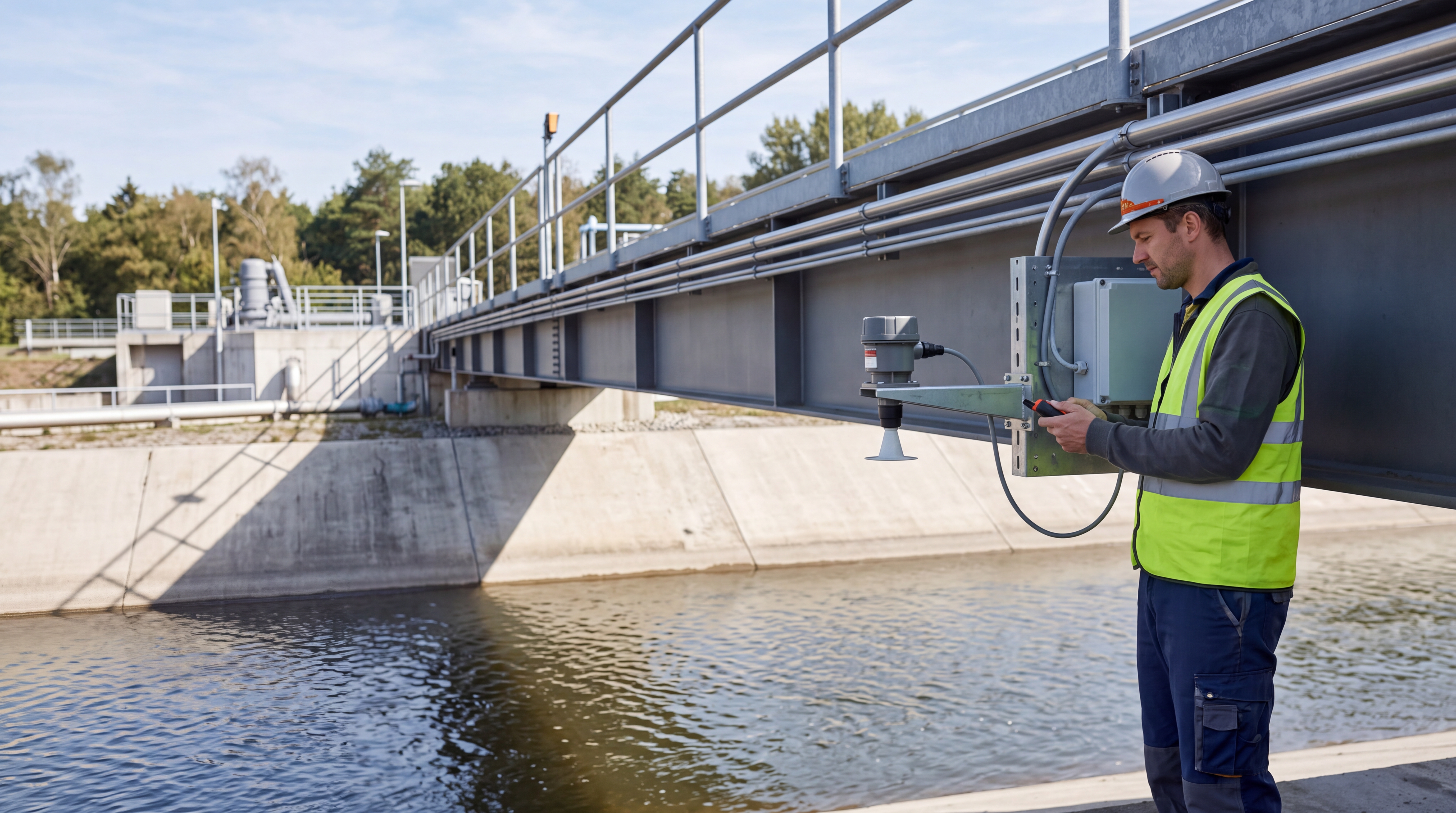
Frequency Band Comparison: Boundaries of 6GHz, 26GHz, and 80GHz
6GHz Radar: The Long-Range Specialist
Advantage: Strong penetration through rain, fog, and steam. Suitable for open reservoirs and high dams with ranges covering tens of meters.
Limitation: Wide beam causes clutter interference in narrow canals or near bridge piers.
26GHz Radar: The Balanced Solution
Currently a mature solution balancing range, beam angle, and cost. Ideal for most rivers, irrigation canals, and municipal pools.
Performance: Stably outputs centimeter-level data in normal wind/wave conditions.
80GHz Radar: High Precision & Small Blind Zone
Represents the direction of high precision. Narrow beam avoids obstacles; blind zone can be as small as 0.1m.
Accuracy: Up to ±1mm-±3mm resolution. Perfect for urban underpasses, narrow canals, and gate monitoring.
Measurement Principles: Pulse vs. FMCW
Pulse Radar: Simple structure, clear signal path. Best for long-range applications but often has a larger blind zone (0.3m–0.5m).
FMCW (Frequency Modulated Continuous Wave): Continuously transmits signals with changing frequencies. It mixes the received echo with the transmitted signal to calculate distance.
Why FMCW wins for water level: Beat frequency measurement is highly sensitive to tiny distance changes, allowing for millimeter-level resolution and smaller blind zones, which is critical for water level monitoring.
However, high precision also depends on algorithms. Mature products use FFT, Constant False Alarm Rate (CFAR), and wave tracking filtering to extract true water surface positions from wind and wave noise.
Radar vs. Other Technologies
Placing radar gauges in the broader context reveals their specific advantages:
- Ultrasonic: Lower cost, but easily affected by temperature gradients, wind, fog, and foam. Less stable in harsh weather compared to radar.
- Pressure/Submersible: Direct contact with water. Susceptible to silt, corrosion, and biological attachment. Requires frequent maintenance in rivers with high sediment.
- Float Gauges: Mechanical components prone to jamming, freezing, and debris entanglement. High maintenance volume for remote stations.
- Radar: Non-contact, all-weather capability, insensitive to water quality changes. Strong comprehensive advantage for open water bodies.
Scenario Adaptation Guide
Rivers & Flash Floods
Wide Rivers: 26GHz or 6GHz for range.
Narrow/Under-Bridge: 80GHz to avoid pier interference.
Reservoirs & Dams
Main Body: 26GHz or low-frequency radars.
Spillways/Gates: 80GHz for narrow spaces.
Irrigation Canals
Widths typically 1-6m. 80GHz is preferred to lock onto the water surface and avoid false echoes from canal walls or weeds.
Urban Waterlogging
Underpasses and low-lying roads need fast response. 80GHz radars with small size and solar/battery power options are ideal for rapid deployment.
Selection Recommendations: 5 Key Aspects
- Determine Range & Blind Zone: Ensure the equipment's blind zone is less than the minimum distance to the water surface. For a 4m installation height with 3.5m min water distance, you need a blind zone < 0.5m.
- Clarify Accuracy Needs: Hydrological metering requires high precision (±1mm-±3mm). Warning systems primarily need fast response and reliability (±1cm is often sufficient).
- Evaluate Beam Angle: Smaller beam = better obstacle avoidance but stricter alignment. For installations near railings or walls, prioritize 80GHz (narrow beam).
- Power & Communication: Remote sites need low power consumption (solar compatible). Choose RS485/4-20mA for local PLCs, or 4G/NB-IoT for remote transmission. Ensure IP66+ rating for outdoor use.
- O&M Capabilities: Look for features like false echo learning, remote diagnosis, and firmware upgrades to reduce long-term maintenance costs.
Outlook: Intelligent Multi-Source Fusion
From industry trends, radar water level gauges are evolving towards higher frequencies, lower power consumption, and greater intelligence. 80GHz technology is expected to expand into digital twin river basins and smart irrigation districts.
Future developments will integrate AI-based echo recognition and self-diagnostic algorithms, moving non-contact monitoring from "equipment availability" to "data credibility." For users, rationally selecting the appropriate route based on specific scenarios is the key to improving real-time monitoring capabilities.