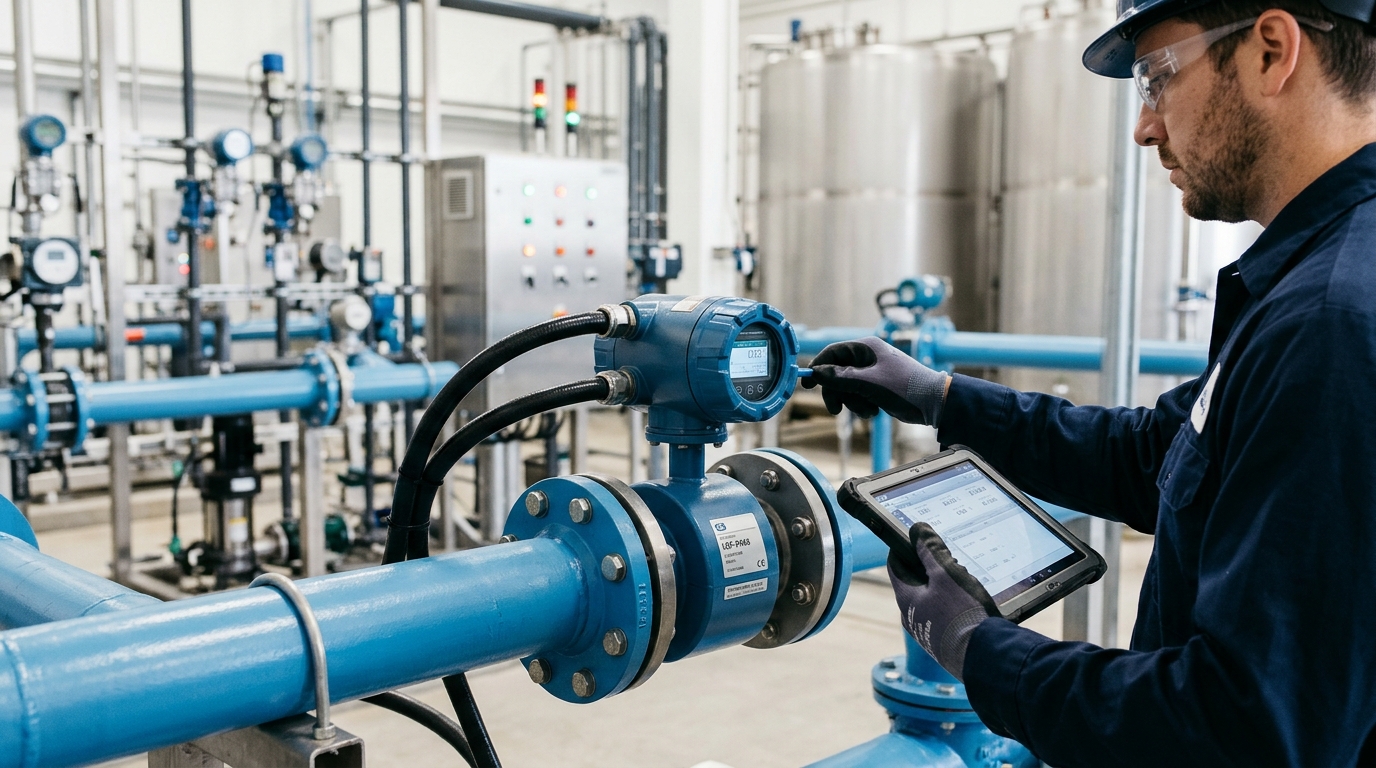
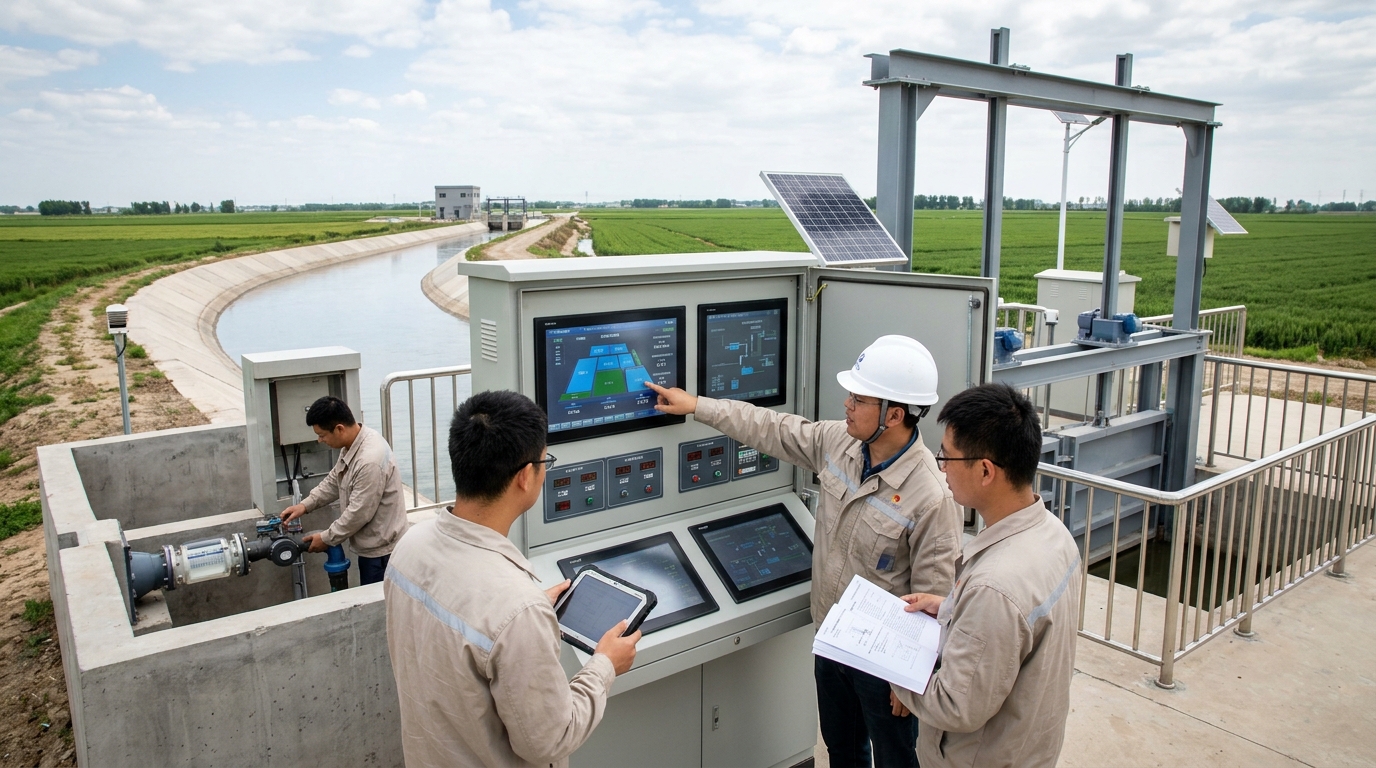
A Smart Water Resources Project in Practice: RTU Telemetry Terminal Application Case
How Hero V9 RTU Terminals Transformed Flood Control and Irrigation Dispatch with 99.3% Data Completeness
Introduction
From March to September 2024, a provincial water resources department deployed 32 sets of RTU telemetry terminals in the “Integrated Monitoring and Dispatch for Flood Control of Small and Medium Rivers and Medium-Sized Irrigation Districts” project. Using the Hero V9 data acquisition and remote transmission terminal as the core device, the project covered 2 small reservoirs, 12 km of key river reaches, 8 control gates, and 4 pump stations. It carried out continuous monitoring of critical elements including water level, rainfall, gate opening, flow, and power supply status.
Acceptance data showed that six months after system commissioning, the average data completeness rate reached 99.3%, the average remote transmission latency was kept within 5 seconds, and the flood warning response time was shortened from hours (manual compilation) to minutes.
Project Background: The Need for Stable Data Acquisition Nodes
Located in the transitional zone between hills and plains, the basin contains numerous small and medium rivers with dispersed levee lengths. Rainfall is concentrated during the flood season, often resulting in fast inflow from upstream and slow drainage downstream. During the 2023 flood season, interruptions in rainfall station data uploads and delayed water level updates made it difficult for dispatch personnel to accurately determine water level differences across gates. Some decisions relied on telephone inquiries and on-site visual inspections.
Legacy System Challenges
- Average data delay during heavy rainstorms: ~38 minutes
- Frequent communication module lockups requiring on-site restarts
- Manual meter reading for irrigation districts
- Tail-end water supply guarantee rate < 75%
Irrigation District Goals
- Main canal length: 28.6 km
- Integration of 4 pump stations and 8 control gates
- Real-time data feed to unified platform
- Improving water utilization coefficient (from 0.58)
To address these issues, the project proponent proposed constructing 32 new sets of RTU telemetry terminals to integrate hydrological and operational condition data into a unified acquisition system, transmitting remotely to a county-level water resources dispatch platform.
Technical Challenges: Power, Connectivity, and Synchronization
Field surveys revealed significant hurdles. 11 of the 32 sites were located outside river levees, more than 1.5 km from mains power. 6 sites were in mountain valleys with 4G signal strength below -110 dBm. 2 reservoir dam-toe sites faced annual waterlogging risks. Power supply became the primary challenge, requiring terminals to operate for no less than 7 days under continuous rainy conditions without data loss.
Another major challenge was sensor complexity. Sites needed to connect radar water level gauges, tipping-bucket rain gauges, gate opening encoders, electromagnetic flow meters, and digital inputs. In early testing, unsynchronized sampling clocks caused misalignments of 5 to 20 seconds between rainfall changes and water level responses, affecting flood hydrograph analysis. Additionally, lightning induction and humidity corrosion threatened long-term stability.
Solution: Building Around the Hero V9 RTU Terminal
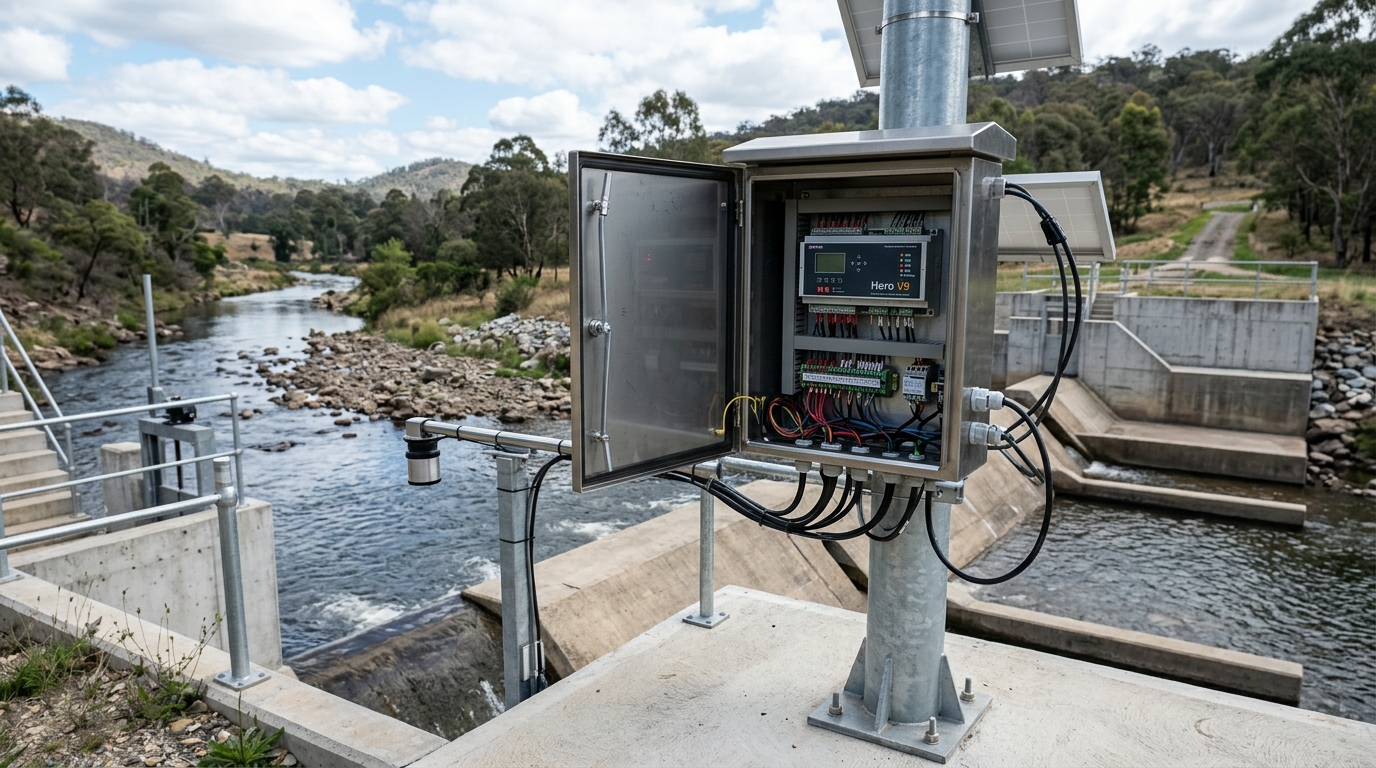
The project team selected the Hero V9 RTU telemetry terminal based on interface capability, power consumption control, environmental adaptability, and protocol compatibility. The terminal supports multi-channel analog inputs, digital inputs, pulse inputs, and RS485 connections, meeting mixed access requirements. With an IP66 protection rating and operating temperature range of -20°C to 60°C, it is suitable for outdoor scenarios like levees and pump stations.
Power Supply Strategy
- Hardware: 100 W monocrystalline silicon solar panel + 100 Ah lithium iron phosphate battery.
- Efficiency: Standby power < 0.8 W; Operating power 2.5–3.5 W.
- Resilience: Tested to run for 7 consecutive days of rain using a 5-minute acquisition/upload strategy.
- Protection: Equipment boxes raised 1.2 m above ground at low-lying sites; added rodent-proof sealing and grounding copper bars.
Data Acquisition Design: Multi-Parameter Access & Edge Preprocessing
Each site was configured with specific sensors based on monitored objects. A single Hero V9 site could connect up to 16 analog channels, 8 digital input channels, 6 RS485 channels, and 4 pulse channels.
| Site Type | Key Sensors Connected |
|---|---|
| Reservoir Upstream | Radar water level, Tipping-bucket rain gauge, Gate encoder, Pressure water level, Digital I/O |
| River Reach | Radar water level, Tipping-bucket rain gauge, Battery status |
| Gate/Pump Station | Electromagnetic flow meter, Motor status, Gate position, Liquid level, Power alarms |
The project implemented tiered data acquisition frequencies. Under normal conditions, water level/rainfall was acquired every 5 minutes. When rainfall exceeded 10 mm/h or during flood season, the system automatically switched to 1-minute high-frequency acquisition. During a June 2024 heavy rainfall event, this dynamic adjustment provided dispatchers with a continuous rising hydrograph.
Built-in edge preprocessing functions handled rainfall pulse counting, water level zero-point correction, outlier removal, and gap interpolation. The terminal filtered invalid jumps smaller than 0.1 mm from jitter pulses and flagged suspected sensor faults while retaining original data.
Remote Transmission: 4G, BeiDou Backup, and Breakpoint Resume
Reliable transmission was key. The 32 terminals used 4G Cat1 as the primary channel. For weak-signal sites, high-gain antennas improved signal strength from -110 dBm to ~-95 dBm, raising upload success rates to 98.5%. For two mountain valley sites without stable public network signal, BeiDou short message served as a backup channel, automatically switching after 10 minutes of 4G failure to upload critical alarm and water level data.
Protocol & Storage
Supports SL651 protocol and pushes structured data via MQTT. Messages contain water level, rainfall, gate opening, flow, battery voltage, and signal strength. Local storage of 8 GB allows retention of at least 30 days of historical data when fully offline. Automatic breakpoint resume prevents permanent data loss upon network recovery.
Data Volume Estimates
• Normal mode (5-min interval): ~9,216 records/day
• High-frequency mode (1-min interval): ~46,080 records/day
• Average upload latency: 3.2 – 4.8 seconds
Implementation Process
The project followed five phases: Survey & Design, Equipment Production, On-site Installation, Joint Commissioning, and Trial Operation.
- Survey (March 2024): Completed site surveys for all 32 locations in 7 days, recording power, signals, and flood risks.
- Production & Testing (April-June): Factory tests verified analog accuracy, RS485 comms, battery charge/discharge, and 4G registration.
- Installation (June-July): Lasted 45 days. Teams installed poles, waterproof enclosures, sensors, and grounding grids. Work proceeded "easy first, difficult later."
- Commissioning (July-August): Verified sensor ranges, protocols, and platform fields. Adjustments were made for pulse anomalies and address conflicts.
- Trial Operation (August): 20-day monitoring of online rates and latency before final acceptance.
Final Results: Efficiency and Safety Gains
The September 2024 acceptance report confirmed an average system online rate of 98.7%. Alarm information (water level limits, sudden rainfall, device offline) is pushed to on-duty personnel within 60 seconds.
During a June 2024 rainfall event (186 mm/24h), the system enabled dispatch recommendations 3 hours in advance. Early gate adjustments reduced backwater by 12 cm. Post-project metrics show the irrigation district water distribution cycle shortened from 14 to 9 days, and the tail-end water supply guarantee rate rose to 89%. Annual O&M cost savings are estimated at 386,000 yuan.
Outlook: Towards Closed-Loop Operations
This case demonstrates that the value of hydrological telemetry terminals extends beyond simple data transmission. By providing stable acquisition, reliable remote transmission, and standardized protocol integration, they offer quantifiable evidence for flood control and irrigation management. The Hero V9 enabled 32 dispersed sites to form a unified monitoring network.
Future projects recommend integrating telemetry terminals with gate control, video surveillance, AI recognition, and digital twin models to form a “monitoring—warning—dispatch—feedback” closed loop. As water resources monitoring evolves from single data upload to full-process management, RTU telemetry terminals remain critical foundational nodes for refined flood control and resource management.
Recommended Configuration Boundary for Similar Zones: 100W Solar + 100Ah Battery, IP66 Protection, 4G Primary / BeiDou Backup, 30+ Days Local Storage, Dynamic Acquisition Frequency.