How to Choose a Suitable RTU Telemetry Terminal? Accuracy and Stability Are Key
Introduction: In scenarios such as digital twin water conservancy, smart irrigation districts, flash flood disaster warning, river and lake chief system monitoring, and urban-rural drainage scheduling, RTU telemetry terminals are evolving from single data acquisition devices into field nodes that integrate sensor access, edge processing, remote transmission, resumable transmission, and security protection. For water conservancy projects, an RTU must not only collect data such as water level, rainfall, flow, water quality, and gate status, but also operate stably under complex communication conditions, field power supply conditions, and long-term unattended operation. Around typical RTU products such as Hero V9, the industry has developed different technical routes, including wired industrial type, cellular public network type, LoRa private wireless type, satellite and BeiDou backup type, edge intelligence type, and multi-mode convergence type. This article compares the above routes from the perspectives of technical architecture, parameter characteristics, applicable scenarios, and selection recommendations, providing an objective reference for the design of water conservancy monitoring and remote transmission systems.
I. RTU Technical Route Differentiation: From "Data Channel" to "Field Edge Node"
Early RTU telemetry terminals had relatively simple technical goals: collect sensor data through serial or analog interfaces, then upload data to central platforms via channels such as GPRS and 4G. As water conservancy monitoring expanded from single water level and rainfall to flow, water quality, engineering safety, gate control, and video linkage, terminals no longer need to handle only low-frequency small data packets, but a combined task of multi-type sensors, multiple communication links, multiple protocol conversions, and higher reliability. New-generation RTUs represented by Hero V9 typically emphasize multi-interface, low power consumption, remote transmission, local caching, and edge judgment capabilities, reflecting the transition of the water conservancy sensing layer from "passive upload" to "proactive governance".
The fundamental reason for technical route differentiation is that constraint conditions at water conservancy sites vary greatly. Urban river channels may have mains power and fiber optics; irrigation district canal systems require long-term solar power supply; mountain rainfall stations may rely entirely on batteries; reservoir dams require highly reliable control and redundant communications; flash flood disaster warning requires second-level or minute-level response. Different constraints directly affect data acquisition cycle, communication method, power budget, installation cost, and O&M difficulty. Therefore, RTU selection cannot simply compare price or only look at one communication metric; it should establish a comprehensive judgment based on specific scenarios.
From engineering practice, RTU technical routes can be roughly divided into wired industrial type, cellular public network type, private wireless type, satellite backup type, edge intelligence type, and multi-mode convergence type. They are not mutually exclusive substitutes, but adaptive choices under different constraints.
II. Wired and Industrial Ethernet Route: Stability First
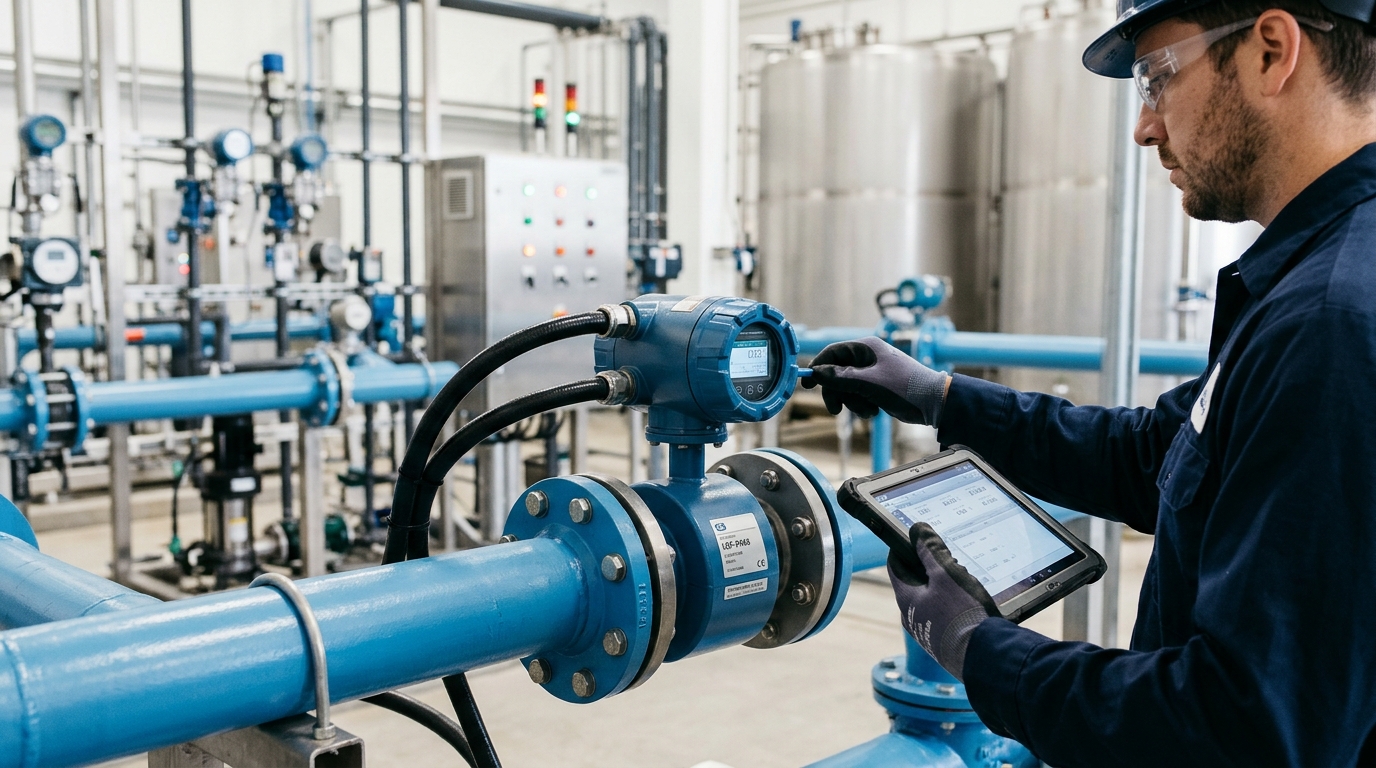
Wired industrial RTUs or industrial acquisition controllers usually rely on Ethernet, fiber optic, RS485, RS232, analog input, digital input/output, etc., connecting to local PLCs, industrial PCs, switches, or central platforms. Typical communication methods include Modbus RTU, Modbus TCP, IEC 104, OPC UA, and the SL651-2014 data communication protocol commonly used in hydrology. Their data acquisition cycles can reach 1 second, 500 milliseconds, or even shorter, suitable for scenarios requiring continuous monitoring and fast linkage. In terms of power supply, such terminals usually use 220V AC, 24V DC, or industrial UPS, and do not rely on long-term solar and battery operation, so they are less sensitive to power consumption.
Advantages
- High stability and sufficient bandwidth
- Strong anti-interference capability
- Suitable for deep integration with control cabinets
- Low latency and high data integrity
Shortcomings
- High wiring construction costs
- Vulnerable to physical interruption (flooding, landslides)
- Requires supporting cabinets and lightning protection
- Higher system complexity
Therefore, wired industrial RTUs are more suitable for key water conservancy projects with stable mains power, existing communication infrastructure, high real-time control, and centralized management, rather than necessarily being the preferred choice for distributed field monitoring sites.
III. Cellular Public Network Route: Wide Coverage & Fast Deployment
The cellular public network route is currently one of the most common remote transmission methods for water conservancy RTUs, mainly including 4G Cat.1, NB-IoT, 4G LTE, and 5G in some scenarios. Different standards vary significantly: Cat.1 usually provides downlink bandwidth around 10 Mbps and uplink around 5 Mbps, network latency mostly between 100 ms and 500 ms, suitable for structured data, device status, images, logs, and protocol messages at certain frequencies; NB-IoT emphasizes low power consumption and small data volume, suitable for low-frequency acquisition such as water level and rainfall, but its uplink rate and real-time performance are weaker than Cat.1; 5G has higher bandwidth, suitable for video backhaul and edge computing collaboration, but still faces challenges in remote area coverage, terminal power consumption, and cost.
The advantages of the cellular route are wide coverage, simple installation, mature platform integration, and relatively convenient O&M. For river channel water level stations, rainfall stations, irrigation district water measurement stations, urban waterlogging monitoring points, and other scenarios, as long as there is carrier signal on site, the RTU can quickly connect to the cloud platform. Taking RTUs such as Hero V9 that support multi-mode remote transmission as examples, common engineering configurations support 4G Cat.1, NB-IoT, or 4G LTE, and can adapt to MQTT, HTTP, UDP, TCP, and SL651 water conservancy data upload protocols.
During selection, it is recommended to first conduct on-site signal testing, clarify carrier coverage, SIM card management, APN configuration, heartbeat cycle, reconnection strategy, and traffic fees, rather than judging only based on product manual parameters.
IV. LoRa and Private Wireless Route: Strong Local Networking
LoRa, private Sub-GHz wireless, Mesh self-organizing network, and other routes are usually used in areas without public network coverage or where traffic costs need to be reduced. Typical LoRa frequency bands include 433 MHz and 470 MHz. Common over-the-air rates are 0.3 kbps, 1.25 kbps, 2.4 kbps, and 5.4 kbps. Line-of-sight communication distance can reach 3 km to 8 km in rural and mountainous areas, but may drop to 1 km to 3 km in urban obstructed environments. Terminal-side power consumption is low. With reasonable acquisition cycles and sleep strategies, combined with 10 Ah to 20 Ah batteries and 5 W to 10 W solar panels, it can achieve battery life of weeks or even months.
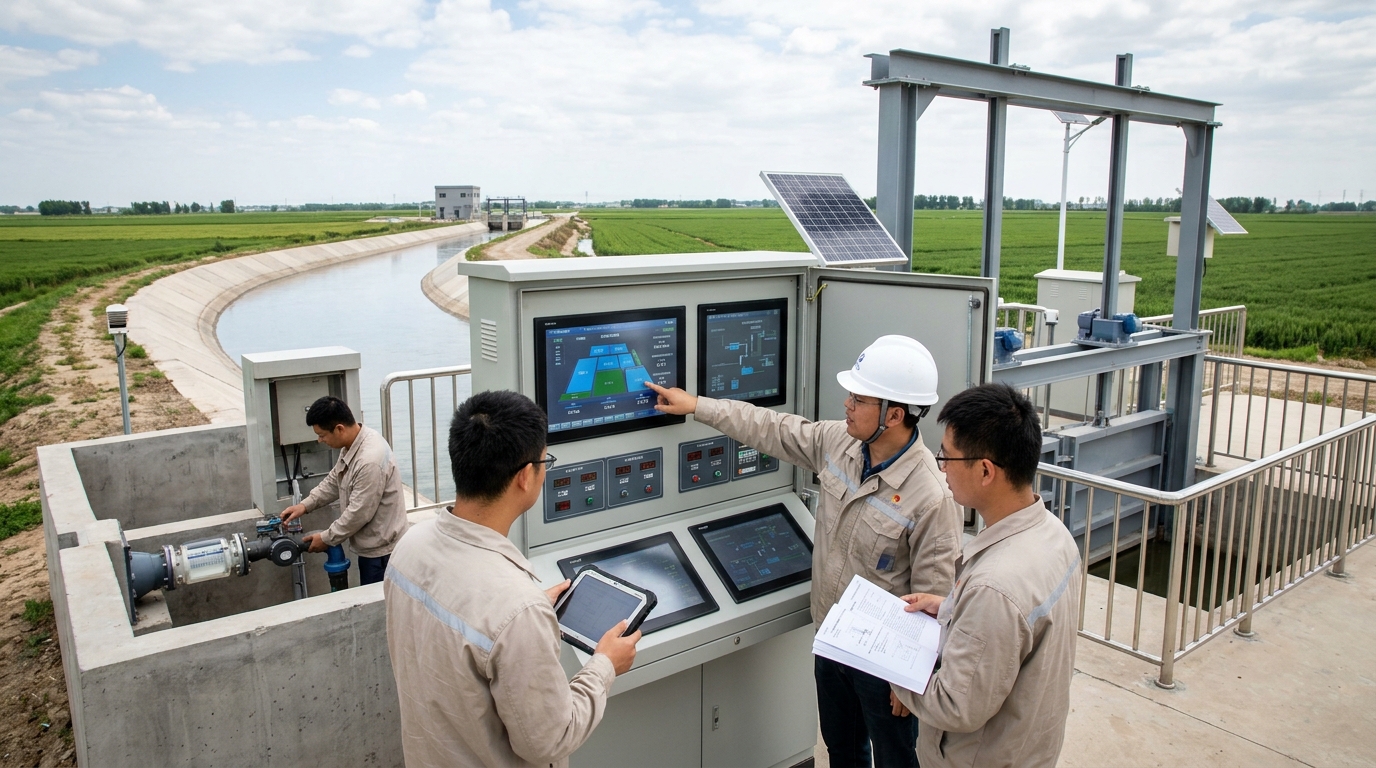
The LoRa route is suitable for irrigation district canal systems, mountain small watersheds, dense rainfall station deployments, township river channels, flash flood gullies, and other scenarios. Its advantage is that it does not rely on carrier traffic and can form a self-organizing network within a local range, suitable for batch deployment of low-power monitoring points. For example, a medium-sized irrigation district can deploy hundreds of measurement points at canal heads, branch canals, sub-branch canals, and gates, aggregate data through LoRa to gateways, and then upload to the central platform via 4G Cat.1 or fiber optic.
Key Limitations
- Gateway Dependency: Gateway failure affects entire area data upload.
- Environmental Impact: Terrain, vegetation, and buildings significantly reduce range.
- Low Rate: Unsuitable for large files, video, or hard real-time control.
- Compliance: Requires careful frequency planning and link budgeting.
V. Satellite and BeiDou Route: Full-Area Backup
Satellite routes mainly include BeiDou short message, Tiantong satellite, high-throughput satellite, and some satellite internet terminals. BeiDou short message is representative in water conservancy emergency and remote monitoring. A single message length is usually tens to hundreds of bytes, suitable for uploading structured small data such as water level, rainfall, and device status, but transmission cycles are often at minute to hour levels. Tiantong satellite or broadband satellite can provide higher bandwidth and transmit images, video clips, or larger logs, but terminal power consumption, antenna size, device cost, and communication fees are usually significantly higher than cellular solutions.
The core advantage of the satellite route is wide coverage area and independence from ground communication base stations. For unpopulated river channels, transboundary rivers, remote reservoirs, and emergency scenarios where public networks are interrupted by earthquakes or floods, satellite communications are irreplaceable. In water conservancy projects, satellites are more often used as backup links rather than primary links. A typical configuration is that the RTU uploads data via 4G Cat.1 or NB-IoT under normal conditions, and automatically switches to BeiDou short message or satellite link when cellular network is interrupted.
Shortcomings include high cost, low rate, large latency, strict installation orientation requirements, and complex power management. It is generally not recommended as the only remote transmission channel for non-critical nodes.
VI. Edge Intelligence and Multi-Mode Convergence
As water conservancy business moves from "seeing data" to "seeing accurately, calculating early, and dispatching quickly", RTUs are no longer merely acquisition and upload tools, but begin to assume edge intelligence roles. Typical capabilities include local data cleaning, outlier removal, sensor fault diagnosis, adaptive acquisition cycles, threshold warning, local calculation of water level-flow rating curves, preliminary rainfall-runoff analysis, resumable transmission, data compression, protocol conversion, and remote firmware upgrade.
Multi-mode convergence is currently an engineering-valuable route. Multi-mode means the same RTU simultaneously supports cellular, LoRa, satellite, Ethernet, or serial private network communications, and automatically switches based on signal quality, power consumption, data priority, and scenario status. For example, in normal status, full data is uploaded via 4G Cat.1; under weak network, key data is uploaded at reduced frequency; when public network is interrupted, data is aggregated via LoRa to nearby gateways; under extreme disasters, BeiDou short message sends critical alarms.
Security Requirements
Water conservancy data may involve dispatch control and public flood prevention information. RTUs need identity authentication, transmission encryption (TLS), device certificates, whitelist access, national cryptographic algorithm support, operation permission grading, and secure firmware upgrade capabilities. Time synchronization and breakpoint caching are also critical for data quality.
VII. Comparison of Typical Water Conservancy Scenarios
| Scenario | Recommended Route | Key Constraints |
|---|---|---|
| Large Reservoir Dam Safety | Wired / Fiber Optic | High reliability, redundant power, lightning protection |
| Urban Waterlogging Monitoring | 4G Cat.1 + Edge Warning | Second-level response, platform linkage |
| Irrigation District Measurement | LoRa Aggregation + Cat.1 Backhaul | Cost balance, dense station deployment |
| Mountain Flash Flood Warning | NB-IoT + BeiDou Backup | Weak signal, battery endurance, emergency comms |
| Water Quality Online Monitoring | Cellular / Wired | Sensor interface precision, remote maintenance |
Case Study: Medium-Sized Irrigation District - An irrigation district deploys about 300 water measurement stations. A hybrid solution of "LoRa aggregation + Cat.1 backhaul" is adopted. Dense stations connect to regional gateways via LoRa, and gateways upload to the platform via 4G Cat.1. Acquisition cycle is set to 5 minutes, water level resolution reaches millimeter level. This reduces single-point communication costs but requires careful gateway location and frequency planning.
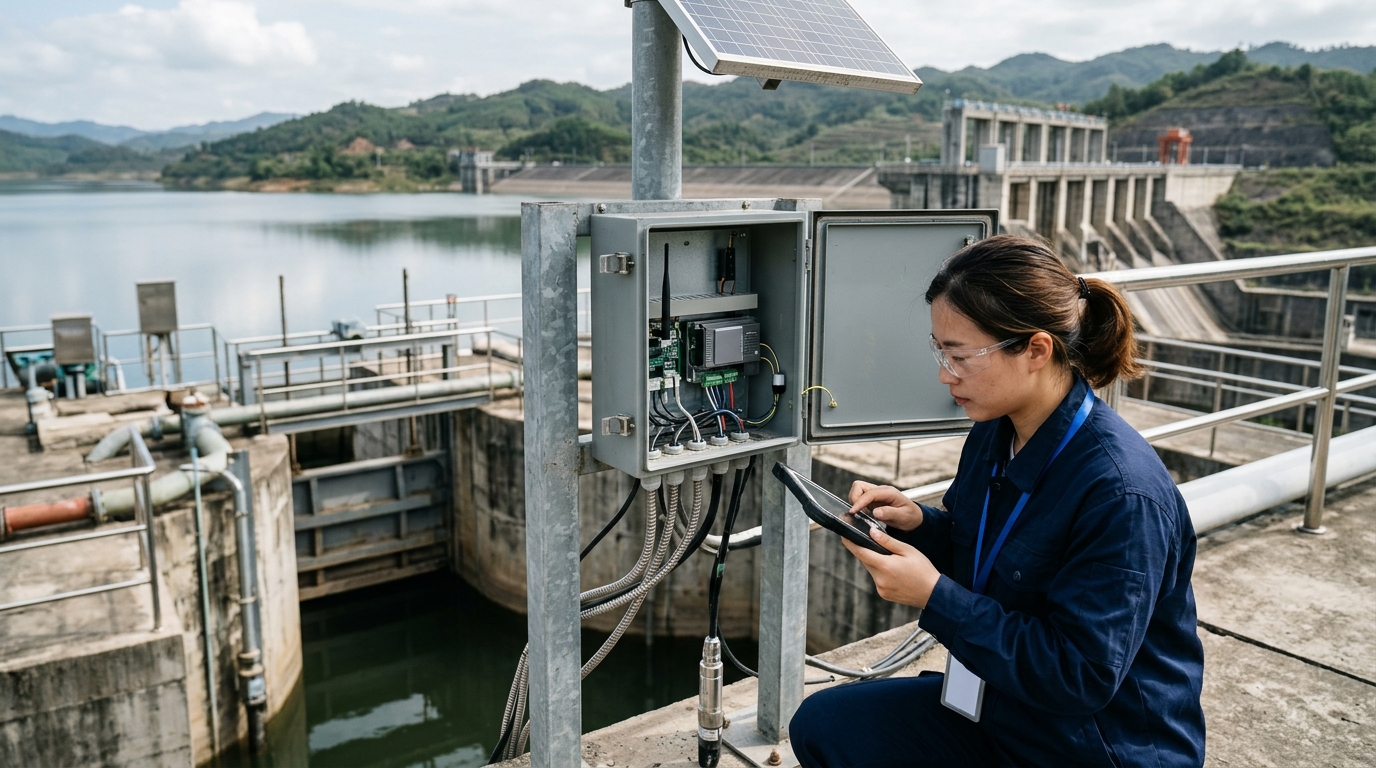
Case Study: Mountain Small Watershed - Deploys 18 rainfall and water level stations with no stable fiber optic. NB-IoT is used as daily remote transmission, BeiDou short message as emergency backup. The RTU caches 72 hours to 30 days of data locally. Power supply uses 10 W to 20 W solar panel plus 20 Ah to 30 Ah battery, requiring 10 to 15 days battery life under continuous rainy conditions.
VIII. RTU Selection Recommendations: Scenario-Based Evaluation Model
For RTU telemetry terminal selection, it is recommended to build an evaluation model from five dimensions:
- Communication Coverage: Conduct field tests of 4G Cat.1, NB-IoT, LoRa, satellite, and other signal quality. Consider fluctuations during flood season, nighttime, rainstorms, fog, and after device obstruction.
- Power Supply and Installation: Clarify mains power, solar power, battery capacity, rainy-day endurance, lightning protection and grounding, cabinet protection rating, and O&M accessibility.
- Data Acquisition: Confirm whether RS485, SDI-12, 4-20 mA, pulse, digital, video, or edge computing interfaces meet sensor requirements, as well as acquisition accuracy, sampling cycle, calibration methods, and data verification mechanisms.
- Remote Transmission and Platform Adaptation: Check whether MQTT, HTTP, TCP, UDP, SL651-2014, and other protocols are supported, and whether resumable transmission, priority upload, heartbeat strategy, reconnection mechanism, and remote configuration capabilities are available.
- Security and O&M: Evaluate device identity authentication, transmission encryption, firmware upgrade, log audit, remote diagnosis, fault alarm, and field maintenance convenience.
Engineering selection should not only focus on "how many communication types are supported", but also whether switching logic is reliable, data caching is complete, power strategies are matched, and interfaces are easy for field maintenance.
From a cost perspective, avoid the "single technical route universal theory". Instead, design combinations based on station location, business priority, budget, and O&M capability. For critical water conservancy nodes, dual-link or multi-link redundancy can be adopted; for ordinary acquisition points, low-power, low-cost, easy-to-maintain solutions can be adopted; for emergency and remote nodes, minimum available communication under extreme conditions should be prioritized.
IX. Outlook: Deepening Toward Low Power & Data Governance
In the coming years, the technological evolution of water conservancy RTU telemetry terminals will continue around low power consumption, high reliability, standardization, edge intelligence, and data governance. On the one hand, as NB-IoT, Cat.1, RedCap, LPWAN, and satellite communication costs decline, remote transmission will become more flexible, and terminals can automatically select the optimal link based on network quality. On the other hand, digital twin water conservancy places higher requirements on data quality; RTUs must not only collect data, but also complete cleaning, verification, anomaly identification, and preliminary analysis locally, reducing "dirty data" uploads.
Standardization will also become an important trend. Hydrological monitoring data communication protocols, MQTT, HTTPS, TLS, national cryptographic algorithms, device identity authentication, and unified O&M interfaces will push different RTU brands to form more consistent access experience on the platform side. For water conservancy projects, selection is no longer just purchasing a data acquisition device, but building a long-term maintainable, scalable, and auditable sensing node system.
Overall, RTU technical routes have no absolute superiority or inferiority, only degree of match with scenarios. Wired industrial type is suitable for hard real-time, hard control, and stable power supply scenarios; cellular public network type is suitable for water conservancy monitoring with good coverage and fast deployment; LoRa private wireless is suitable for dense low-rate acquisition; satellite and BeiDou are suitable for areas without public network and emergency backup; edge intelligence and multi-mode convergence are suitable for complex digital twin water conservancy systems. For water conservancy industry users, a truly effective selection method is to first clarify data acquisition requirements, remote transmission conditions, power supply constraints, response timeliness, and O&M capability, then determine the RTU technical route and configuration combination, ultimately forming a stable, manageable, and trustworthy water conservancy sensing foundation.