5 Critical Technical Pillars of Smart Water Monitoring Systems: A Full-Stack Engineering Perspective
Bridging the gap between pilot projects and reliable, long-term municipal deployments.
Smart water monitoring systems have transitioned from pilot projects to large-scale deployments worldwide. Yet many utilities report that systems become unreliable within 12-18 months of commissioning. This article identifies five critical technical pillars that determine long-term system viability, drawing on field engineering experience across municipal water and wastewater networks.
1 Sensing Layer: Instrument Selection Sets the Performance Ceiling
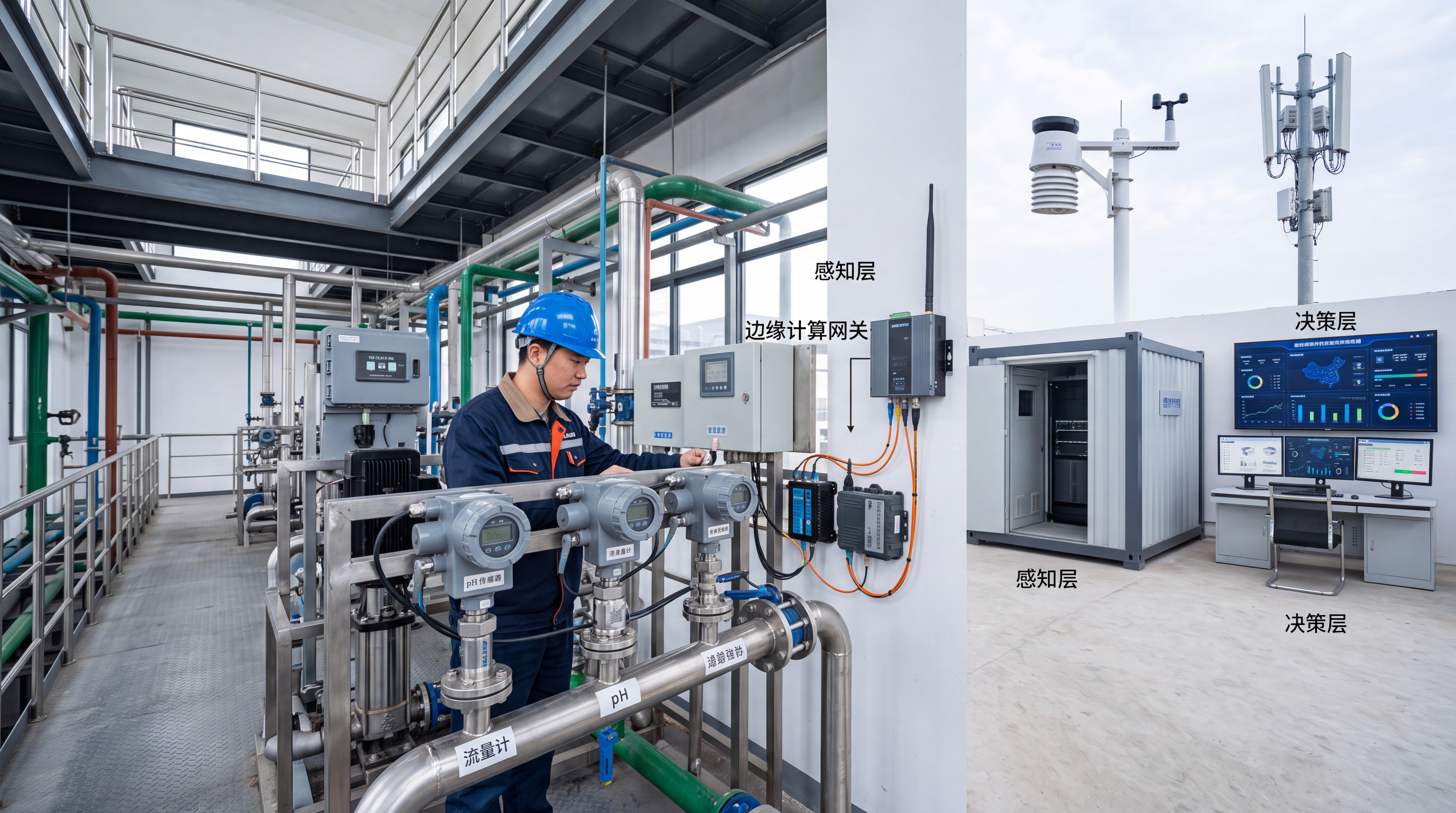
The sensing layer defines the upper bound of system accuracy. For pressurized water mains, electromagnetic flowmeters (±0.5% accuracy, compliant with ISO 4064 and OIML R49) remain the gold standard for DN50-DN2000 full-bore metering. For sewer and open-channel applications, non-contact radar level sensors (26 GHz or 80 GHz FMCW) paired with Doppler velocity probes offer superior reliability in corrosive environments.
Engineering Rule of Thumb: Specify IP68 minimum ingress protection and verify IEC 60068-2 environmental compliance for -20°C to +60°C operation. In sewer manholes, H₂S and CH₄ exposure demands 316L stainless steel or titanium electrodes.
2 Communication Layer: Network Architecture Determines Data Integrity
Water monitoring points are geographically dispersed with limited power availability. Urban networks benefit from NB-IoT (20 dB better penetration than GSM) combined with 4G LTE dual-mode IoT RTU terminals. Remote irrigation districts and hydrological stations are better served by LoRa mesh networks with BeiDou/GNSS short-message backup.
- RTU Specifications: ≥30 days local data buffering, store-and-forward capability, and remote OTA firmware updates.
- Protocol Efficiency: MQTT over TLS 1.2 reduces bandwidth consumption by approximately 60% compared to HTTP polling, with native QoS Level 1 message acknowledgment.
3 Platform Layer: Data Governance as the Foundation of Usability
A mid-size municipal water system typically integrates 2,000-5,000 monitoring points sampling at 15-minute intervals, generating billions of records annually. The platform must address three imperatives:
Time-Series Database
TDengine or InfluxDB, sustaining ≥1M writes/second.
Anomaly Detection
Dual-stage filtering using 3-sigma rules plus sliding-window validation.
Data Fusion
Aligning SCADA, GIS, and meteorological data on a unified timestamp.
Without rigorous data governance, any platform degrades into a data swamp within six months.
4 Analytics Layer: Models Must Match Operational Context
The value of smart water lies in converting raw data into actionable decisions. In DMA (District Metered Area) leakage management, Minimum Night Flow (MNF) analysis provides baseline loss estimation, but pressure-flow correlation analysis is essential for pipe-segment localization. Hydraulic model calibration (EPANET) requires minimum three months of continuous monitoring data.
For urban flood early warning, coupled rainfall-runoff-routing models outperform simple threshold alarms.
? Key Insight: Prioritize model interpretability and maintainability over marginal accuracy gains.
5 O&M Layer: Lifecycle Management Drives Return on Investment
In smart water TCO analysis, capital expenditure represents only 30-40% of total cost; operations and maintenance consume 60%+. Engineering best practices mandate:
- Annual Sensor Calibration: Flowmeters require at least one wet calibration per year.
- Monthly Communication Inspections: Monitor battery voltage decay and signal attenuation.
- Weekly Data Quality Reports: Track completeness, accuracy, and timeliness metrics.
Contractual SLAs should specify ≥95% system availability to prevent the "build-and-abandon" project anti-pattern.
Conclusion
Smart water monitoring success depends not on individual technology sophistication but on full-stack engineering consistency. From sensor ingress protection ratings to communication protocol selection, from data governance frameworks to algorithm maintainability, every layer must be designed for a 10-year operational horizon.
For system integrators, standardized deployment workflows and structured O&M programs deliver greater commercial value than chasing emerging technologies.