Commissioning a smart water monitoring network is straightforward; keeping its data decision-grade for years is not. Many utilities discover that six months after acceptance, pressure readings drift, minimum night flow (MNF) analysis becomes unreliable, and operators mute alarms they no longer trust. In practice the failure point is rarely sensor accuracy — it is data-chain governance. This article covers six technical points with parameters that can go straight into a specification.
1. Sampling: event-driven beats fixed polling
Fixed-interval sampling (e.g. every 5 minutes) wastes bandwidth and battery during steady state yet misses transients when they matter. The engineering answer is hybrid sampling: report every 10–15 minutes under normal conditions, and trigger a burst mode (e.g. every 30 s for 10 minutes) when the pressure rate of change exceeds roughly 0.02 MPa/min or flow steps beyond a configured threshold. For DMA schemes, MNF analysis needs continuous data between 02:00 and 04:00; tighten the interval to 1–5 minutes in that window and relax it elsewhere to protect RTU battery life.
2. Time synchronisation: one network, one time base
Cross-site analytics — MNF, leak localisation by pressure-wave correlation, transient tracking — is meaningless unless timestamps align. Low-cost RTU oscillators can drift ±20 ppm (≈1.7 s/day), accumulating more than 10 s per week: enough to destroy a cross-correlation. Mandate NTP or network-based time sync on every RTU, store in UTC, display in local time, and verify at acceptance that each node holds ±1 s against a reference clock.
3. Drift calibration: write it into the O&M contract
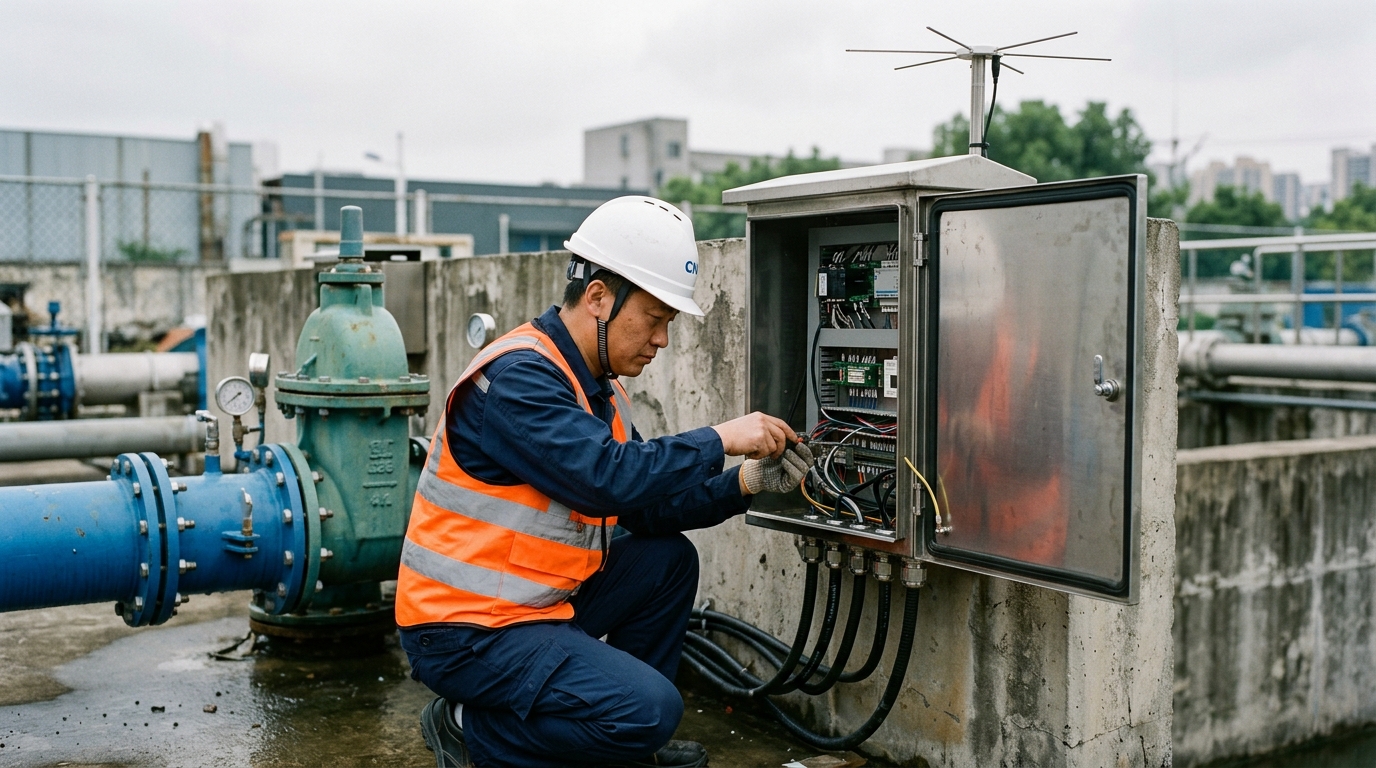
Pressure transmitters typically drift ±0.25–0.5% of full scale per year; electromagnetic meters in wastewater service can pick up 1–3% error from electrode fouling. Design the calibration path in: specify instruments with zero-point self-check, and RTUs that accept remote zero and span corrections. Put “12-monthly field comparison for pressure points, 6-monthly zero checks for flow meters” into the O&M SLA rather than relying on reactive maintenance.
4. Communications: match the link to the data density
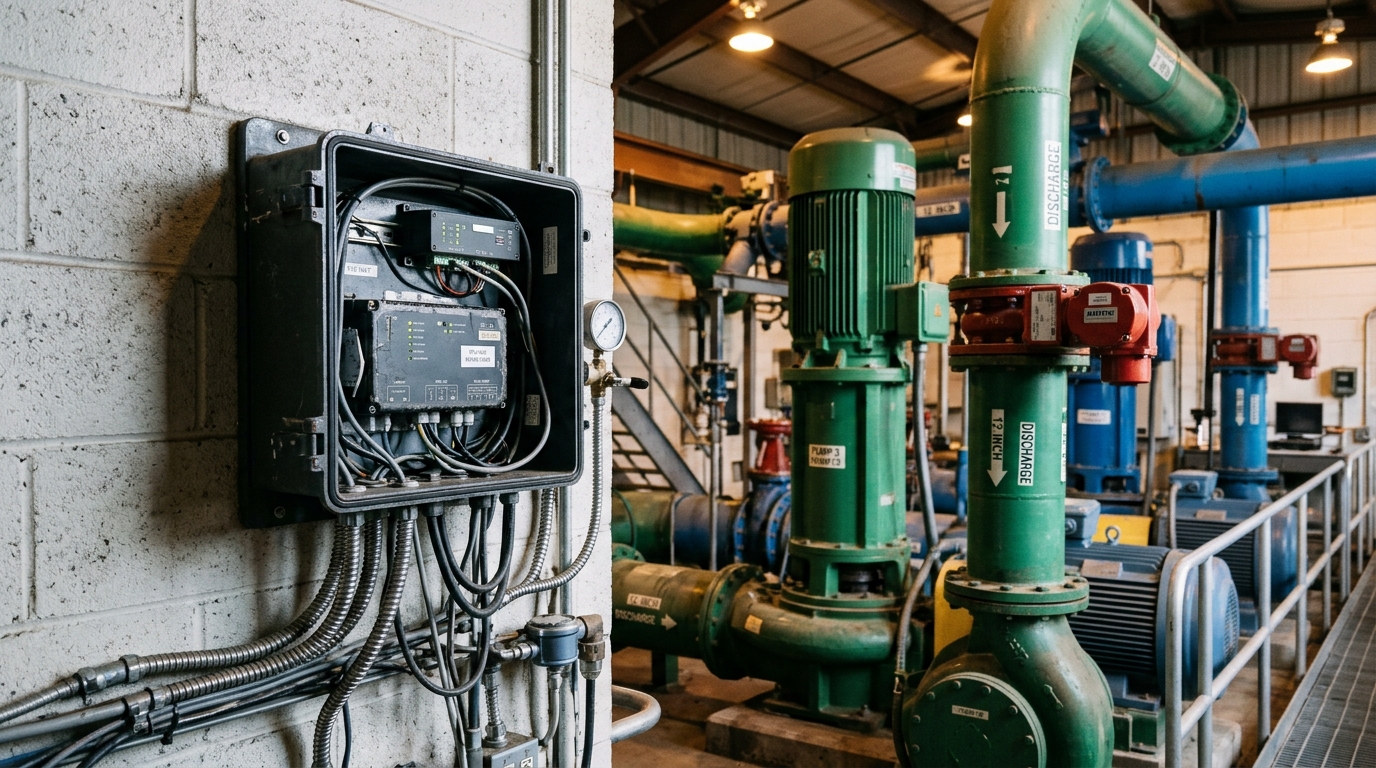
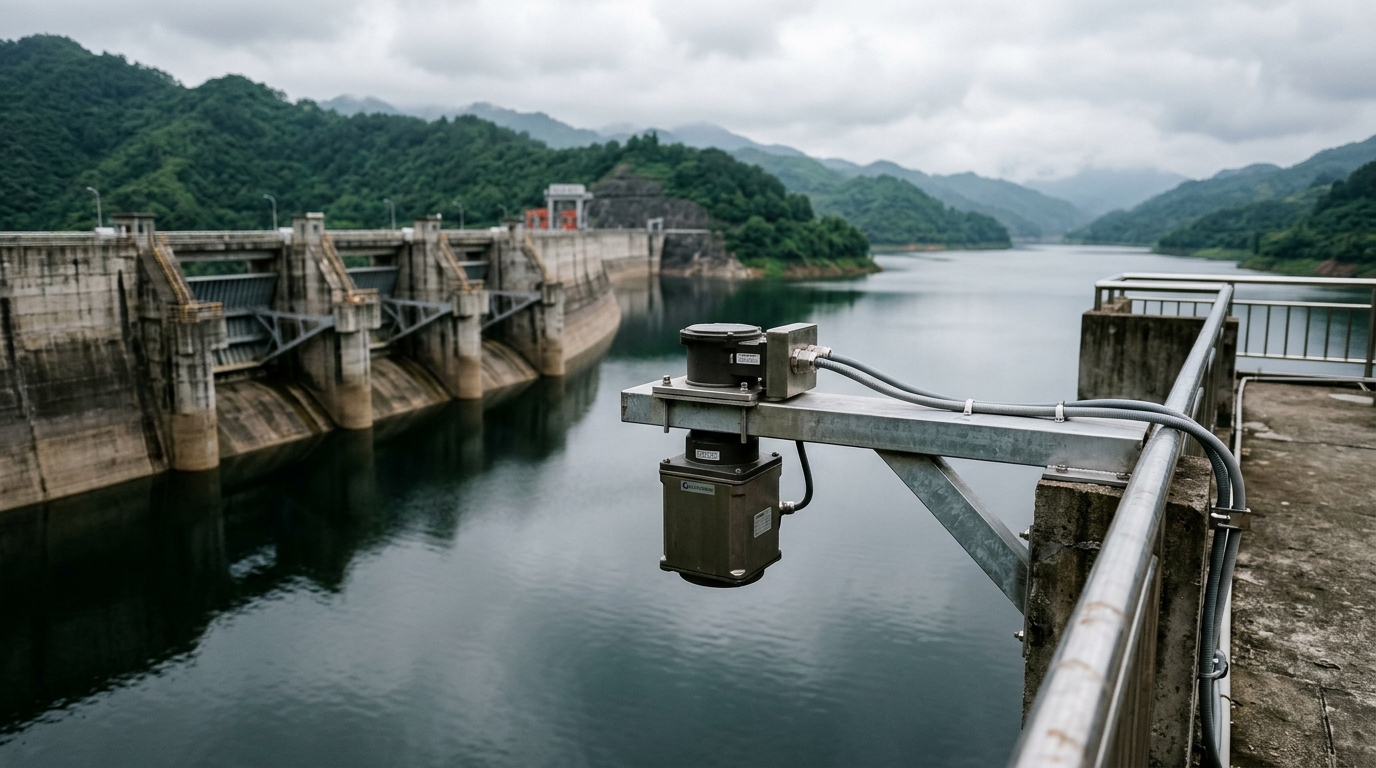
NB-IoT fits low-rate pressure and quality points but imposes small payload limits — pack binary frames, not JSON. 4G Cat.1 suits pump stations and gated structures with image capture or high-rate sampling. Private LoRa gateways work well in dense legacy districts with poor cellular coverage. Standardise on MQTT over TLS with topics hierarchised as zone/type/device-id and QoS 1. Every RTU must buffer at least 30 days of data locally and support store-and-forward backfill after outages.
5. Alarm thresholds: tier them and suppress the noise
A single fixed threshold is the direct cause of alarm storms. Use three levels (warning / alarm / critical) with dynamic baselines — for instance, pressure limits that follow the diurnal demand curve. Add suppression rules: no repeat notification from the same device within 5 minutes, and merge causally related upstream/downstream events into one root-cause alarm. Field experience shows well-tuned suppression cuts nuisance alarms by more than 70%.
6. Data SLA: treat data as a contracted deliverable
Manage the data stream itself under service levels: completeness ≥98%, timeliness (≥95% of records arriving within 10 minutes), and validity ≥95% after removing negative, out-of-range and frozen values. The platform should compute these daily, publish them on an O&M dashboard, and drill failures down to the specific RTU or link segment — so degradation surfaces before it corrupts decisions.
Conclusion
The competitive edge in smart water is shifting from “how many sensors are installed” to “can the data support decisions”. These six points are interlocking: a gap in any of them will be repaid later as distorted data or ignored alarms. Specify them during design, and validate against real telemetry during trial operation before formal acceptance.