From Technical Challenges to Successful Implementation: A Chronicle of the Implementation of a Smart Water Management Project
Case Study: DN50 Anti-Corrosion Electromagnetic Flowmeter in Fine Chemical Wastewater Reuse
In the water systems of industries such as chemical, pharmaceutical, electroplating, and new energy materials, electromagnetic flowmeters are commonly used for the continuous metering of conductive liquids. However, when the medium simultaneously features high chloride ion content, weak acid/alkali fluctuations, thermal cycling, and high outdoor humidity, the long-term stability of the instrument is often challenged.
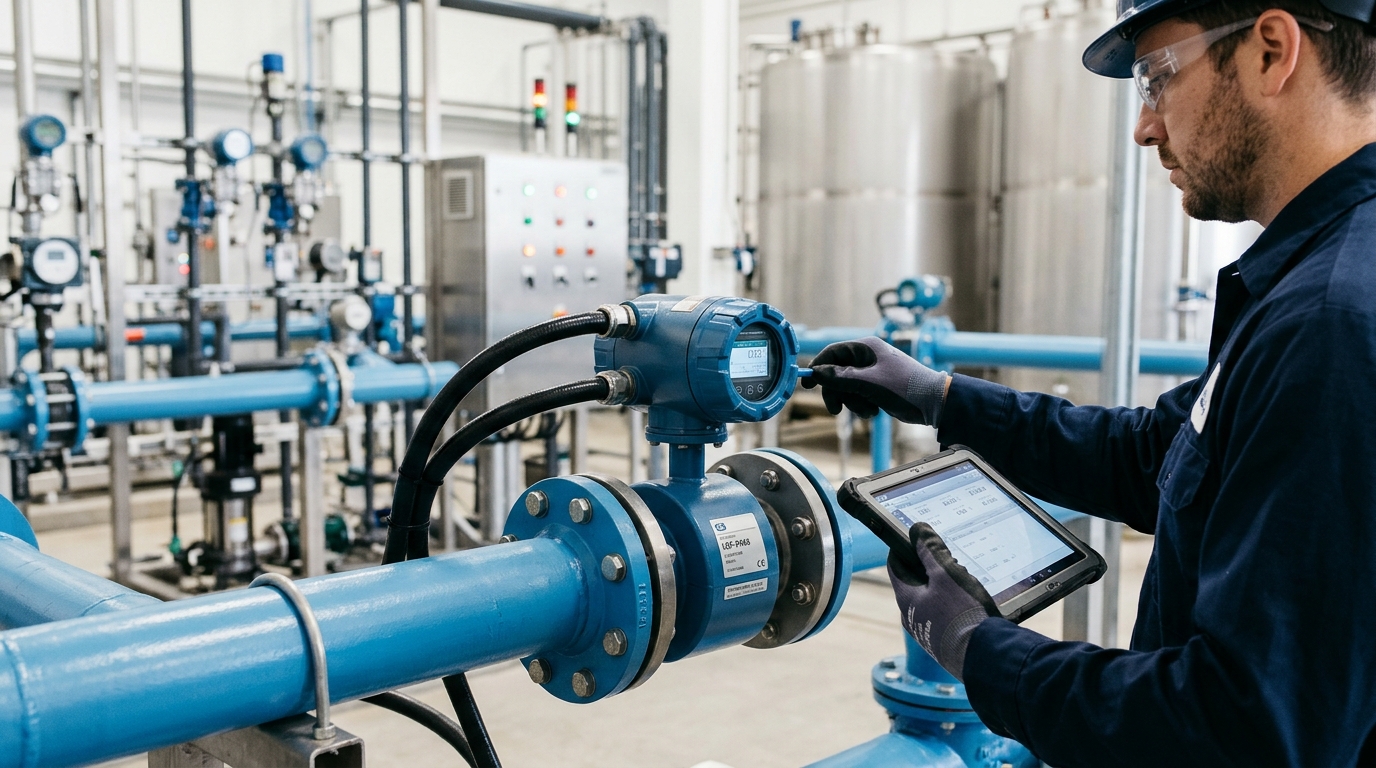
Recently, the Yicai Technology News Editorial Department compiled an engineering application case of an electromagnetic flowmeter: a deep wastewater treatment and reuse project in a fine chemical park in East China. An anti-corrosion electromagnetic flowmeter was adopted on the DN50 dosing and neutralization water pipeline, and the corrosion resistance of the housing, flange, and wiring chamber was improved through an LGF-PA66 injection-molded integrated structure. After 12 months of operation, the on-site metering error was controlled within ±0.35%, and the maintenance frequency was reduced from once a month to once a quarter, providing a referable engineering sample for similar corrosive working conditions.
Project Background: Metering Bottlenecks in the Fine Chemical Wastewater Reuse System
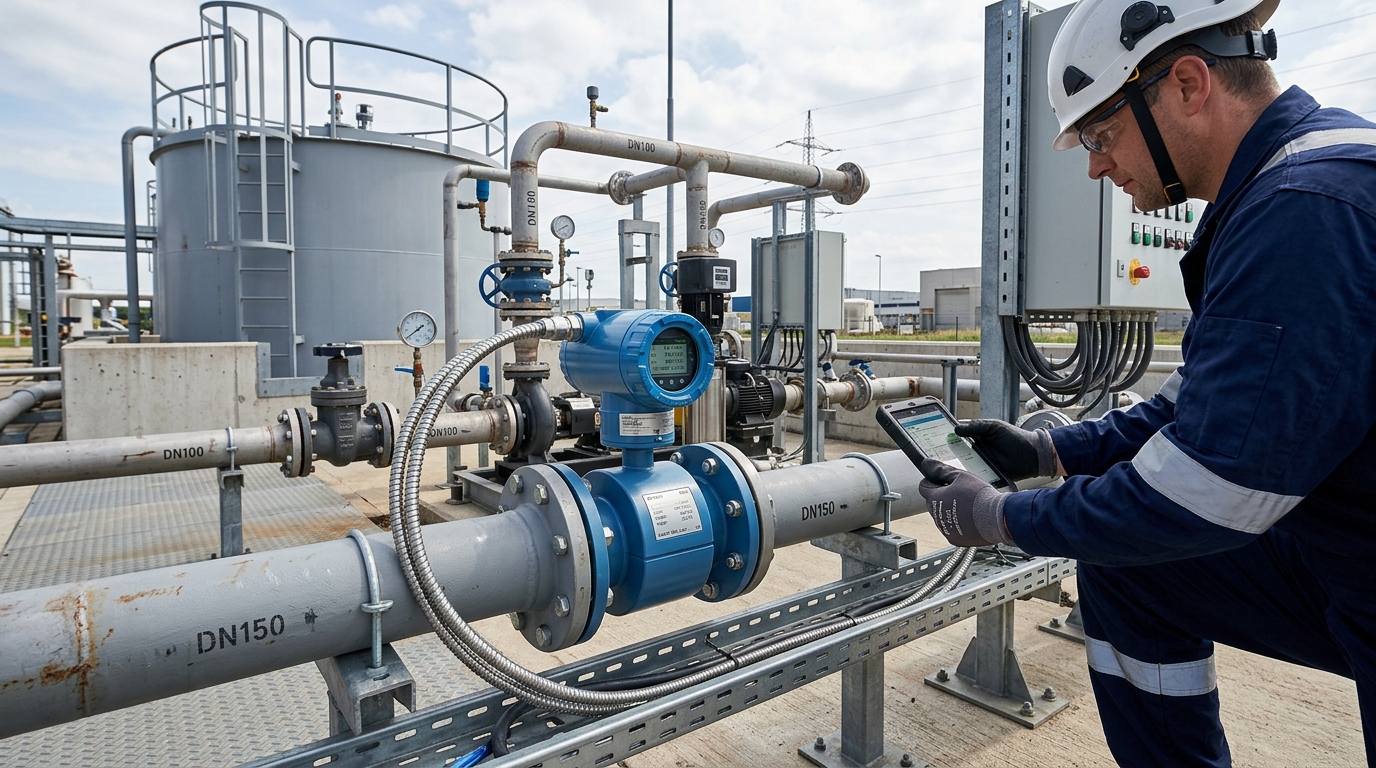
Located in a coastal chemical park in East China, the project's deep wastewater treatment design capacity reached 12,000 cubic meters per day after the third phase of expansion, with a reuse rate target of 65%. The system includes an equalization tank, neutralization reaction, coagulation sedimentation, multi-media filtration, activated carbon adsorption, and reuse water storage.
Key Parameters
- Nominal Diameter: DN50 (Plastic-lined steel pipe)
- NaCl Mass Fraction: 1.2% – 2.8%
- pH Range: 4.8 – 9.2
- Conductivity: 6,800 – 11,200 µS/cm
- Temperature: 28℃ – 58℃
- Pressure: 0.20 MPa – 0.68 MPa
Flow Conditions
- Common Flow Rate: 4.5 m³/h
- Max Instantaneous Flow: 9.6 m³/h
- Location: Between neutralization tank outlet and dosing mixer
In the initial stage of the project, three small-diameter electromagnetic flowmeters with standard configurations were installed at this location. After about 10 months of operation, the owner's equipment management department recorded various abnormalities: rust and leakage appeared at the flange connections, the converter wiring chamber suffered terminal oxidation due to wash water intrusion, the anti-corrosion coating on the housing partially blistered, and the instrument zero point drifted.
On-site inspection data showed that the maximum deviation between the instantaneous flow rate displayed by one instrument and the set value of the dosing pump reached +4.8%, while another instrument had a zero shift of about 0.035 cubic meters per hour after empty pipe recovery.
Due to fluctuating metering data, the neutralization dosing control had to be switched from automatic to manual empirical adjustment, affecting both chemical consumption and effluent qualification rate.
Technical Challenges: Superposition of Corrosion, Leakage, and Signal Drift
From the perspective of working conditions, the technical difficulties of this DN50 pipe section are not due to a single factor, but a composite problem formed by the superposition of corrosion, leakage, mechanical stress, and signal interference.
Corrosion & Environmental Stress
High chloride ion concentration and pH fluctuations make ordinary carbon steel and aluminum alloy housings unstable. Coastal salt spray accelerates external corrosion.
Fluid Attachment
Flocculant and detergent residues attach to the liner-electrode interface, affecting induced electromotive force acquisition.
Mechanical Vibration
Pump vibration (1.1 mm/s) and water hammer cause alternating stress on flange connections.
Signal Interference
Improper grounding (resistance 38-56 Ω) coupled with power cable interference caused irregular flow jumps of ±0.3 to ±0.5 m³/h.
Renovation Goals: Control metering error within Class 0.5, meet long-term anti-corrosion requirements, and extend maintenance cycle to more than 3 months.
Solution: LGF-PA66 Injection-Molded Integrated Structure
In response to the above working conditions, the project technical team conducted an overall design of the instrument structure, materials, and measurement system. The parts in contact with the medium follow the mature anti-corrosion route: PTFE liner, Hastelloy C276 electrodes, and titanium grounding ring.
Material Innovation: LGF-PA66
Long glass fiber reinforced polyamide 66 replaces traditional metal housings.
- Tensile Strength: ~190 MPa
- Flexural Modulus: ~13.5 GPa
- Heat Deflection Temp: ~245℃
- Water Absorption (24h): < 0.8%
- Chemical Resistance: No change after 168h in 5% HCl/NaOH
Structural Integration
Injection-molded integration reduces assembly gaps.
- Integrates flange, housing, wiring chamber, and cable entry.
- Reduces 8 exposed bolts and 4 assembly gaps.
- IP68 Protection Rating achieved via integrated sealing groove.
- No water ingress after 1-meter depth, 72-hour immersion test.
To improve on-site maintainability, the converter retains a replaceable terminal module. In response to vibration at the pump outlet, a flexible short pipe is added between the LGF-PA66 injection-molded integrated flange and the pipeline, and support brackets are set on both sides of the sensor, reducing the vibration velocity transmitted to the instrument body from 1.1 mm/s to below 0.4 mm/s.
Implementation Process: From Calibration to Commissioning
On-site Survey & Straight Pipe Optimization
Upstream straight pipe section increased from 160 mm to 320 mm, and downstream from adjacent elbow to 210 mm, ensuring fully developed flow.
Factory Calibration
Verified using 0.5-class standard meter. Indication errors at 1.5, 4.5, and 9.0 m³/h were +0.12%, -0.04%, and +0.08% respectively, all meeting Class 0.5.
Installation & Grounding
Titanium grounding ring installed. Grounding resistance dropped significantly from 38–56 Ω to < 8 Ω. Shielded twisted pair cables grounded at one end to avoid ground loops.
Parameter Configuration
Low-frequency excitation mode selected for high conductivity media. Small signal cutoff set to 0.02 m/s. Empty pipe and electrode contamination diagnostics enabled.
DCS Joint Commissioning
Flowmeter linked with pH meter and metering pump for proportional dosing. 72-hour trial run completed with no false alarms or signal interruptions.
Operational Data: Accuracy, Stability, and Cost Reduction
The operational data after the renovation serves as the core basis for evaluating the effectiveness of this solution. Four on-site comparisons were conducted on the 30th, 90th, 180th, and 360th days of operation.
| Metric | Before Renovation | After Renovation |
|---|---|---|
| Metering Error | Up to +4.8% / Zero Shift | < ±0.35% (Class 0.5 Qualified) |
| Flow Fluctuation (Start/Stop) | ±0.42 m³/h | ±0.03 m³/h |
| Maintenance Frequency | Once a Month | Once a Quarter |
| Grounding Resistance | 38 – 56 Ω | < 8 Ω |
Maintenance man-hours were reduced by about 20.4 hours annually. Calculated on an annual basis, the number of maintenance work orders decreased by about 76%. Due to the reliable sealing of the wiring chamber, no signal faults caused by water ingress occurred within 12 months of project operation.
Engineering Value: Verifiable Benefits
From an engineering perspective, the value of this case lies in integrating materials, structure, installation, and control logic into a verifiable system. The LGF-PA66 injection-molded integrated structure solves the problems of traditional metal housings being prone to corrosion and having many assembly gaps.
Chemical Savings
Neutralization chemical dosage reduced by 9.7% (from 18.6 L/h to 16.8 L/h). Flocculant dosage decreased by 6.2%. Annual savings approx. 187,000 RMB.
Quality Improvement
Reuse water quality qualification rate increased from 97.2% to 99.5%. Backwashing frequency reduced, saving approx. 1,800 m³/year in self-use water.
This case also reflects the boundary conditions of electromagnetic flowmeters in corrosive fluid applications. Medium conductivity must meet measurement requirements (here 6,800–11,200 µS/cm), and anti-corrosion cannot rely solely on the housing. Engineering details such as installation straight pipe sections, grounding resistance, and shielded wiring have an impact on final stability no less than the performance of the instrument itself.
Concluding Outlook
With the increasing requirements for water resource reuse in projects such as chemical parks, new energy materials, electronic chemicals, and comprehensive seawater utilization, small-diameter, corrosive fluid metering scenarios will continue to increase. Although the DN50 pipeline is not large in diameter, it often appears in dosing, sampling, bypass, and key control points, and its metering accuracy directly affects chemical consumption, emission compliance, and process stability.
This case shows that the next step in the development of anti-corrosion electromagnetic flowmeters is not just to improve the corrosion resistance of a single component, but to combine engineering plastics such as LGF-PA66, injection-molded integrated molding, intelligent diagnostics, and on-site installation specifications to form an overall solution more suitable for complex working conditions.
Through digital interfaces such as HART and Modbus, parameters including factory calibration, grounding resistance, and electrode contamination trends can enter the equipment management system, realizing the transition from "periodic maintenance" to "condition-based maintenance." The significance provided by this DN50 case lies in: under complex corrosive working conditions, metering stability can be obtained and quantitatively verified through the collaborative optimization of material processes, structural design, and engineering implementation.
Related Products
LGF Integrated Electromagnetic Flowmeter
LGF integrated electromagnetic flowmeter (DN15–DN100) with ±0.5% accuracy for water treatment, DMA district metering and industrial flow measurement — IP68, lightweight composite body, factory-direct from Ecolor.