Background: The Last Mile of Urban Drainage Monitoring Is Inside the Manhole
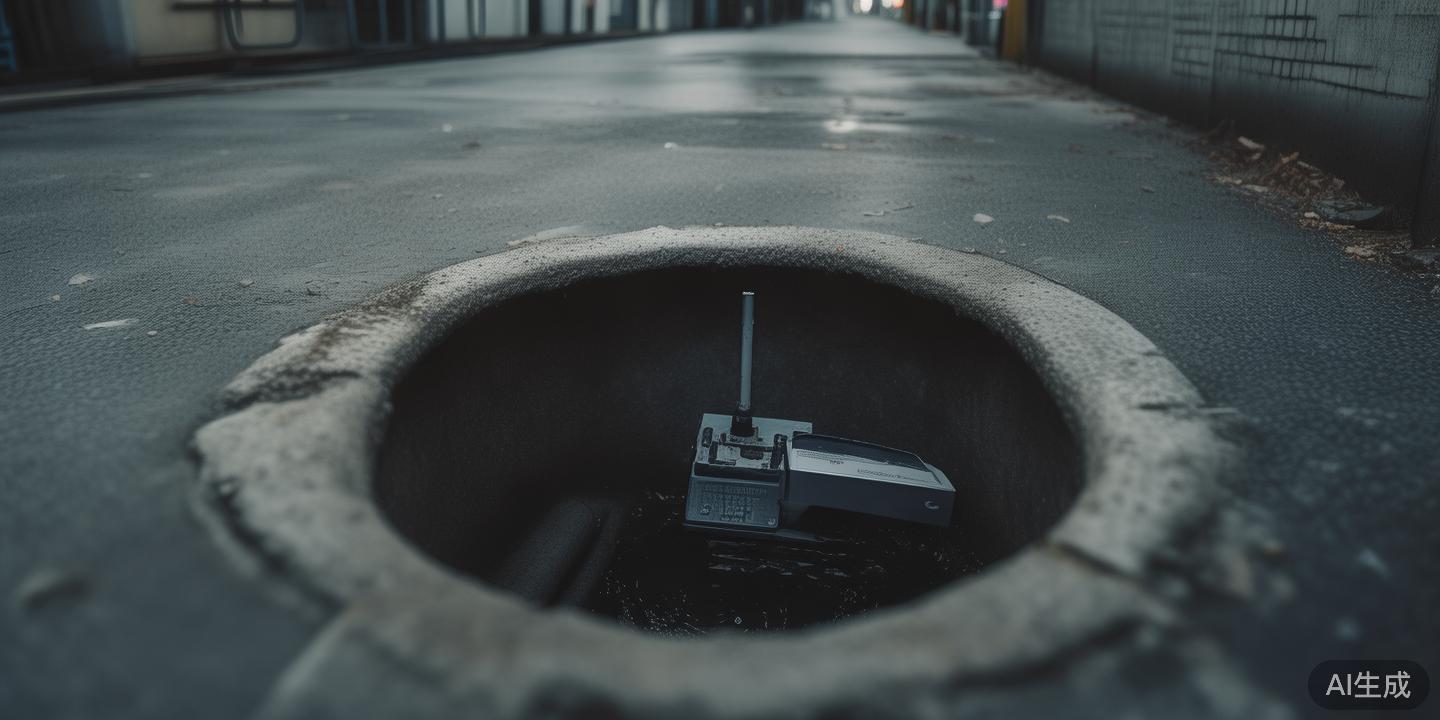
Urban drainage networks are critical "urban lifeline" infrastructure, yet their monitoring coverage remains low worldwide. Unlike hydrological stations or pump houses, sewer monitoring nodes sit inside manholes: no mains power, no wired network, confined space, and a highly corrosive atmosphere. An IoT RTU for this duty must therefore be engineered for below-grade service, not for a control room. This article distills lessons from multiple Sewer Flow Monitoring deployments into three engineering priorities.
Priority 1: Ingress Protection and Corrosion — IP68 Is Only the Starting Point
Manholes stay near saturation humidity, and daily thermal cycling produces condensation directly on electronics; H₂S and CH₄ from sewage fermentation attack terminals and solder joints. Practical countermeasures:
- Require IP68 verified by immersion testing (1 m, 72 h), with potted connectors or waterproof aviation plugs — "waterproof housing, leaking connector" is the most common field failure we see;
- Conformal coating on all PCBs and physical separation of the battery compartment from the electronics compartment;
- Where flammable gas accumulation is possible, prefer intrinsically safe designs, mount the RTU just below the cover for better ventilation, and validate against the IEC 60068 series for damp heat and salt mist.
Priority 2: Power — Budget the Battery for Five Years, Not One
With no mains power and solar blocked by the manhole cover, lithium thionyl chloride (Li-SOCl₂) packs are the mainstream choice. Using a 19 Ah / 3.6 V cell with four reports per day as a baseline: sleep current must stay below 20 µA and each measure-and-transmit cycle under 0.15 Wh to reach a 4–5 year service interval. Low temperature sharply reduces usable capacity (roughly −30% at −10 °C), so northern deployments should size the pack for worst-case winter conditions — add cells in parallel rather than raising report frequency.
Priority 3: Connectivity — Assume Signal Attenuation Under the Cover
Reinforced-concrete manhole covers attenuate RF by 10–20 dB; in deep chambers 4G Cat.1 routinely falls below −110 dBm. Workable strategies include routing the antenna just under the cover or using RF-transparent covers; favoring NB-IoT, whose ~20 dB link-budget advantage over GPRS fits below-grade coverage gaps; and for dense urban grids, a Low-cost Sensing architecture of LoRa nodes aggregating to street-level gateways. Always survey actual signal levels at the real manhole locations before rollout — never estimate from base-station distance on a map.
Recommended Architecture: Tiered Node Density
Classify network nodes into three tiers: trunk-line critical sections (level + flow, 15-minute reporting), waterlogging risk points (level only, with automatic event-triggered densification during storms), and general nodes (low-frequency patrol reporting). When pairing the RTU with Doppler flow meters or radar level sensors, insist on dual RS-485/Modbus and SDI-12 protocol support plus local store-and-forward buffering of at least 30 days.
Conclusion
Urban drainage monitoring succeeds or fails on RTU survival underground, not on the platform dashboard. IP68 with corrosion hardening, a five-year battery budget, NB-IoT-first connectivity, and tiered node density form today's best cost-performance combination. Require third-party IP68 test reports and measured power-consumption data from vendors, and run a pilot through one full rainy season before scaling.